NASA · USA · 1997–now

Mars Rovers
A quarter-century of American robots driving across Mars — from a microwave-sized cart that managed about a hundred metres to a nuclear astrobiologist caching rock for the trip home.
Robotic campaign ACTIVE
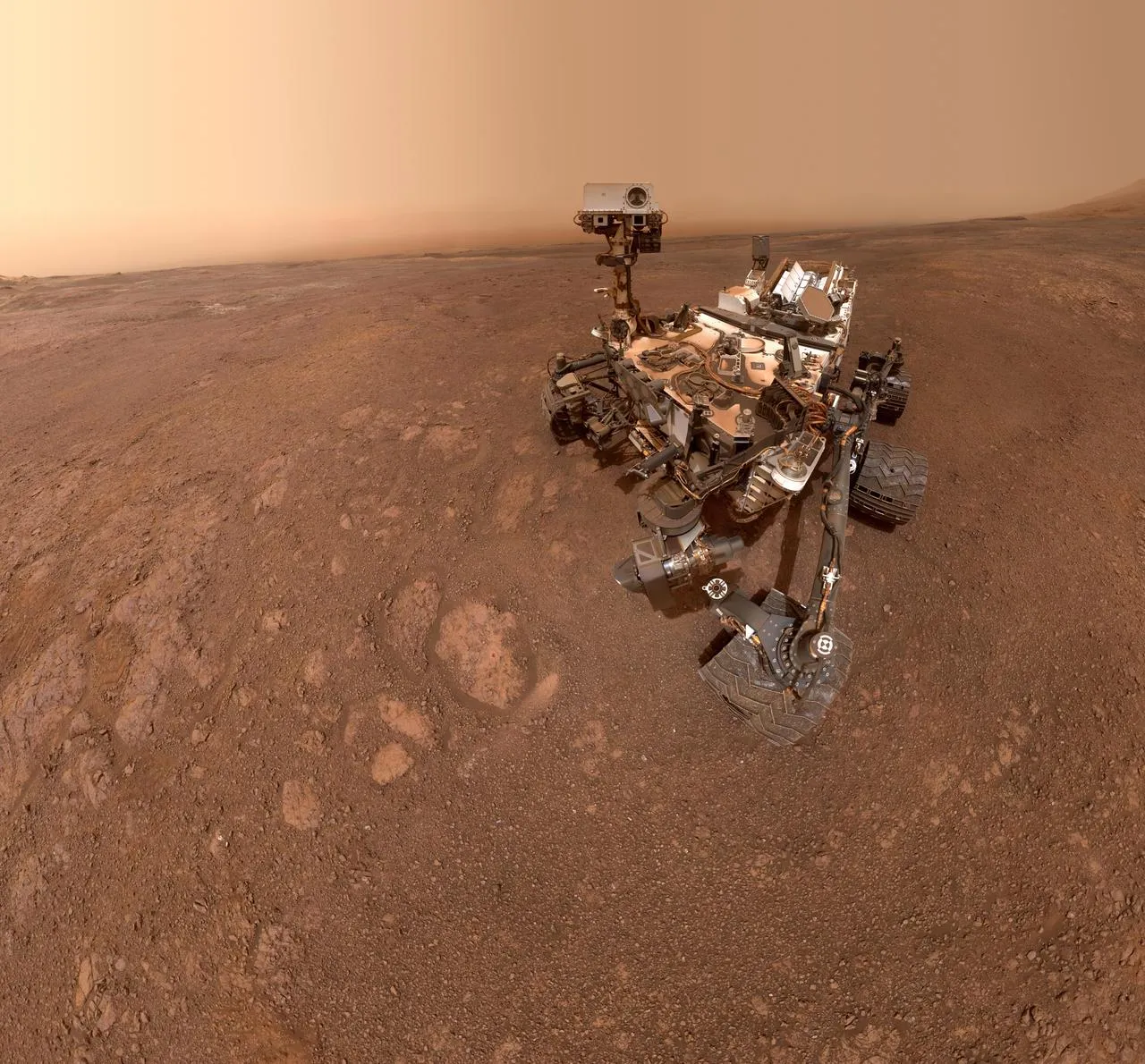
The land
The Viking landers of 1976 had proved a spacecraft could reach the surface of Mars and work — but they were stuck where they touched down, able to study only what lay within reach of a single arm. Mars is a whole planet, its history written across terrain that stretches for thousands of kilometres, and a lander sees one spot of it. To read the record — to find where water once flowed, to sample rocks laid down billions of years ago — a robot would have to move.
The Mars rovers are NASA's twenty-five-year answer to that problem: a lineage of wheeled robots, each larger and more capable than the last, sent to drive across the planet and do field geology in person. They begin with a proof of concept the size of a microwave and arrive, a quarter of a century later, at a nuclear-powered laboratory hunting for the chemical fingerprints of ancient life.
Goals
The goal evolved with each generation, but the thread was constant: follow the water, and then follow the question of life. Sojourner set out only to prove that a rover could drive on Mars at all. Spirit and Opportunity were sent to find geological evidence of a warmer, wetter past. Curiosity went to ask whether Mars had ever been habitable. Perseverance went to look for signs that something had actually lived — and to begin the job of bringing Martian rock back to Earth.
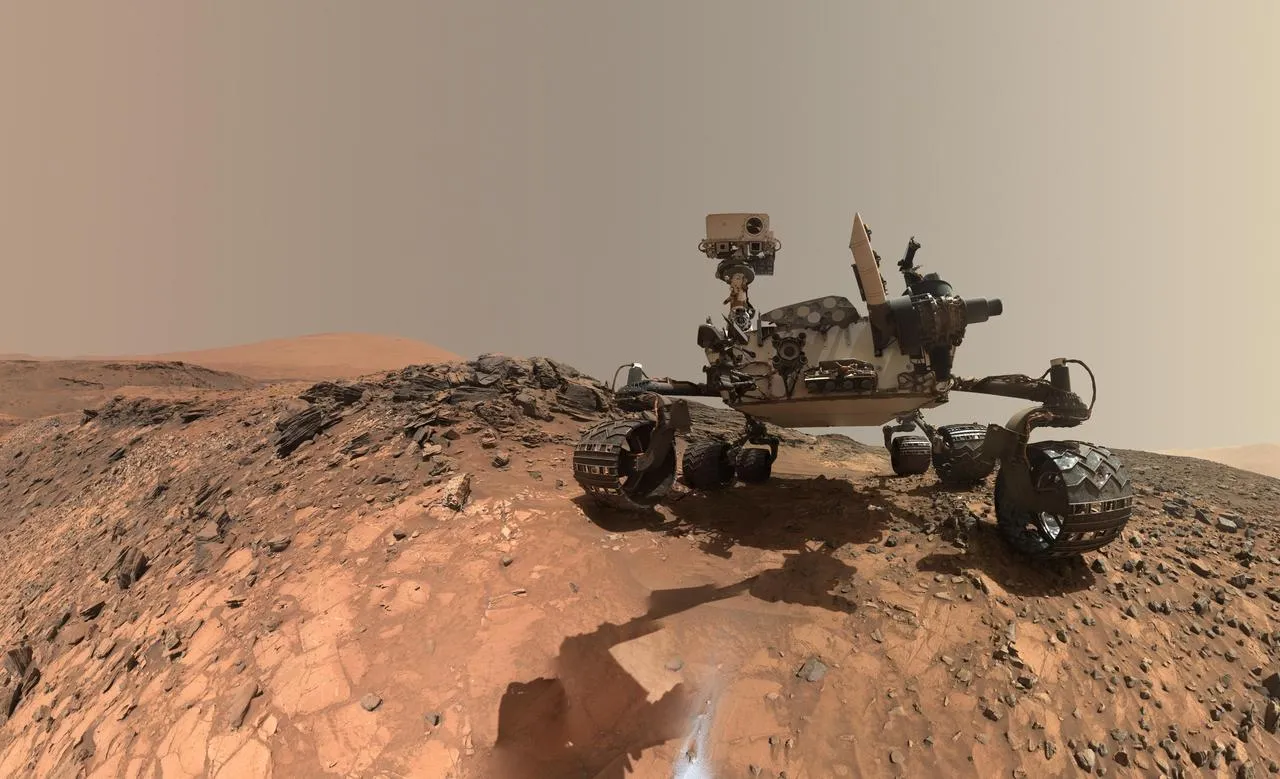
Underlying all of it was mobility as a scientific instrument. A rover's real power is that it can go and look — drive to the interesting rock, climb the crater rim, cross to the ancient riverbed — turning Mars from a single landing site into a landscape a geologist can survey, one drive at a time.
Outcome
The rovers vastly outlived their plans, and each rewrote what Mars had been. Sojourner, in 1997, drove about a hundred metres and proved the concept. Spirit and Opportunity, landed in 2004 on ninety-day missions, worked for six and fourteen years respectively — Opportunity crossing more than forty-five kilometres, the longest drive on any other world — and found clear chemical evidence that liquid water had once stood on the surface.
Curiosity, lowered into Gale Crater in 2012 by a rocket-powered sky crane after a landing sequence so audacious its planners called it seven minutes of terror, confirmed the case: the crater had once held a lake, with the chemistry a living thing could have used. Perseverance followed in 2021, landing on the floor of Jezero Crater — home to an ancient river delta — to search directly for signs of past life and to seal Martian rock in sealed tubes — the first stage of a campaign to bring samples of another planet back to Earth.
Perseverance also carried a passenger that made its own history: Ingenuity, a small helicopter that in 2021 made the first powered, controlled flight on another planet, and then flew dozens more times — proof that Mars could be explored from the air as well as the ground. Curiosity and Perseverance are both still driving.
The story
The story of the Mars rovers is one long argument, made in wheel tracks, that Mars was once a world where life was possible. Each rover advanced it a step: Sojourner proved the method, the twins proved the water, Curiosity proved the habitability, Perseverance went hunting for the life itself. No single mission settled the question, but together they turned Mars from a cold red desert into a planet with a warm, wet youth — and made the search for ancient Martian life a serious science rather than a fantasy.
It is also a story about robots that refused to die. Spirit and Opportunity were built for ninety days and worked for years; Opportunity drove the length of a marathon across a planet, surviving dust storms and a stuck wheel and a decade of cold nights, until a global storm finally silenced it in 2018. The rovers earned a genuine public affection almost unique among machines — mourned when they failed, cheered when they woke — because they were, unmistakably, explorers, doing in slow motion what a human geologist would do on foot.
And the lineage is a study in incremental ambition. Nobody could have landed Perseverance's sky-crane, sample-caching complexity in 1997; it took Sojourner's hundred metres to justify the twins, the twins' years to justify Curiosity, and Curiosity's lake to justify sending a rover to look for life and start the long road to sample return. Each rover was the platform that made the next one thinkable — a quarter-century of building capability one mission at a time.
What it gave back
The rovers' first legacy is the modern Mars: a planet now known to have had standing water, habitable chemistry, and a warm early history, established not by inference but by robots that drove to the rocks and read them. The scientific case that Mars could once have hosted life rests almost entirely on their wheel tracks.
Their second is the technology of surface mobility — the sky crane, the autonomous navigation, the nuclear power, the aerial scouting of Ingenuity — a toolkit built up rover by rover that now makes it possible to explore a planet's surface as a landscape rather than a spot, and that any future surface mission, crewed or robotic, inherits.
Their third is still in transit: the sealed tubes of Martian rock that Perseverance is caching, waiting for a future mission to carry them home. If that campaign succeeds, the rovers will have delivered the first samples ever returned from the surface of another planet — the payoff of a twenty-five-year drive.
What we can learn
The lesson of the Mars rovers is that mobility changes everything. A lander studies where it falls; a rover studies where it chooses to go. By making the instrument move, the program turned a single landing site into an entire planet's worth of geology — a reminder that on any frontier, the ability to go and look for yourself is worth more than any amount of fixed observation.
The deeper lesson is that great capability is built in steps, not leaps. Perseverance's sample-caching sophistication was unimaginable in Sojourner's day; it became possible only because each rover earned the next. Ambitious ends are usually reached not by a single decisive mission but by a patient lineage, each member proving enough to justify the one that follows — progress as a relay, not a sprint.
Missions
- 1997
 the low-cost mission that bounced onto Mars on airbags and let Sojourner, a microwave-sized rover, become the first wheels to turn on another planet
 - 2004 landed in 2004 on a 90-day mission and worked for six years, finding chemical traces of Mars's warmer, wetter past
- 2004 Spirit's twin, which drove more than 45 kilometres over 14 years — the longest distance any vehicle has covered on another world
- 2012 a car-sized, nuclear-powered rover lowered onto Mars by a rocket-powered sky crane in 2012, which confirmed that Gale Crater once held a habitable lake
- 2021
 landed on the floor of Jezero Crater in 2021 — an ancient river delta and lake bed — to search for signs of past life and seal samples in tubes for a future mission to bring home
 - 2021 Ingenuity a small helicopter carried by Perseverance made the first powered flight on another planet in 2021, and went on to fly dozens more times