NASA · USA · 1975–1982

Viking
In 1976 two American landers set down on Mars, sent back the first clear photographs from its surface — and ran an experiment to answer the oldest question about the planet: is anything alive there?
Robotic campaign COMPLETED
The land
By the mid-1970s Mars had been glimpsed but never touched. Mariner flybys and one orbiter had replaced the old dream of canals and civilisations with a colder picture — a cratered, apparently dead desert — but the surface itself remained unknown, and the question that had haunted Mars for a century was still open. Was there life? A photograph from orbit could not answer it. Someone had to land, look, and test the soil.
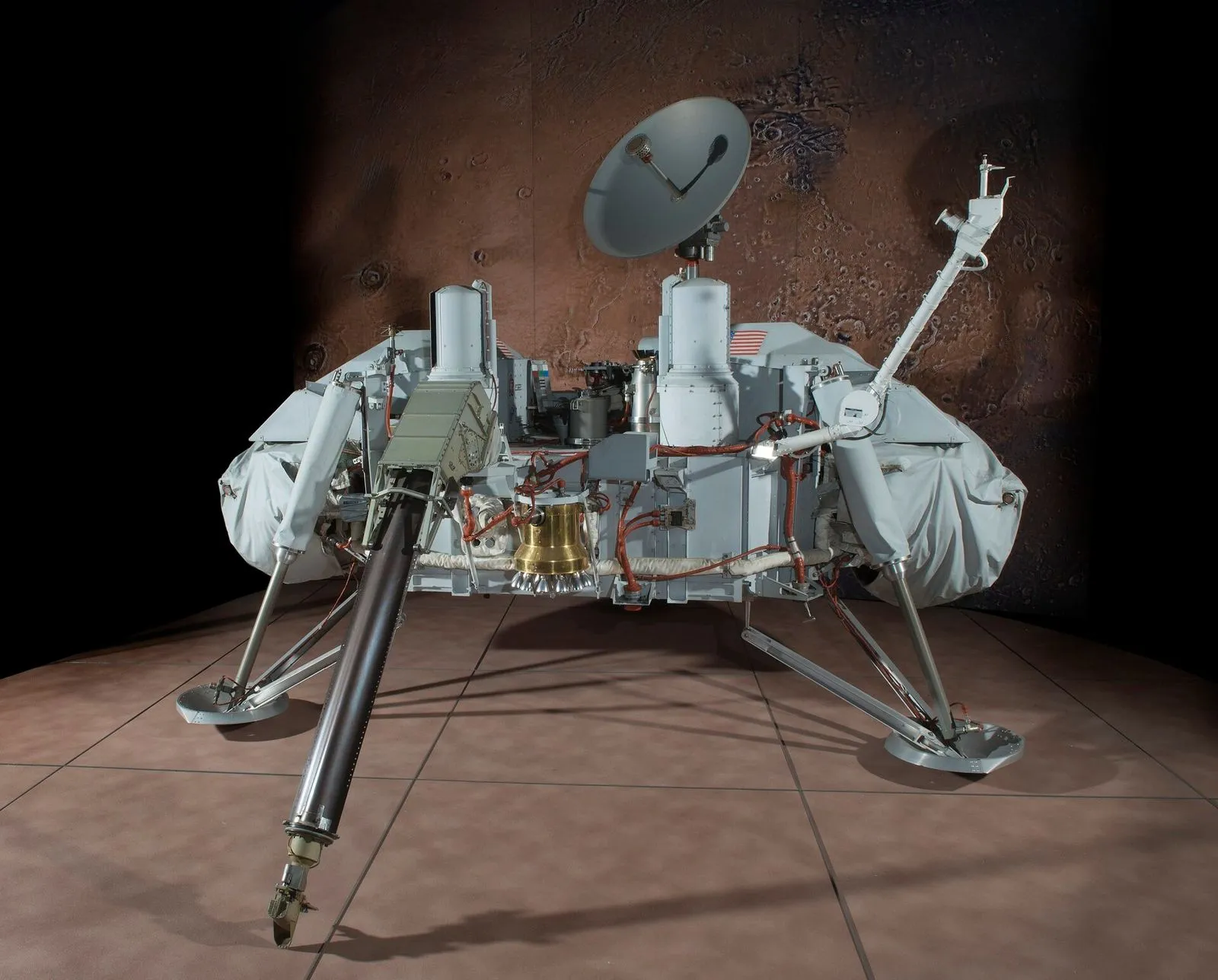
Viking was the most ambitious interplanetary mission the United States had yet attempted: two identical spacecraft, each an orbiter carrying a lander, sent to reach Mars, choose a safe spot from above, and set a robot down gently on a world whose surface no one had seen from the ground. Nothing had ever landed on Mars and worked; the Soviet attempts had failed within seconds. Viking had to succeed twice.
Goals
The goal had two halves. The orbiters would map Mars from above in detail no flyby could — enough to choose landing sites and to study the planet as a whole. And the landers would do what nothing had done before: operate on the Martian surface, photograph it, measure its weather and soil, and run a suite of experiments built to detect the chemistry of life.
The life question was the one the public cared about, and Viking took it seriously. Each lander carried three separate biology experiments, designed to feed the Martian soil and watch for the signs of metabolism — the most direct search for extraterrestrial life ever attempted, then or since.
Outcome
It worked, twice. The Viking 1 lander touched down in Chryse Planitia on 20 July 1976 and returned the first clear photograph from the surface of Mars — a rock-strewn orange plain under a pale sky. Viking 2 set down in Utopia Planitia six weeks later. Between them the two landers operated for years, sending back panoramas, seasons of weather data, and the first detailed chemistry of the Martian soil.
The biology results were the mission's great ambiguity. One of the three experiments returned a signal that, on Earth, would have suggested life; the others did not, and the lander's chemistry instrument found no organic molecules in the soil at all. The scientific consensus settled on an unusual, life-mimicking chemistry in the Martian dirt rather than biology — but the result was close enough, and strange enough, that it is still argued over decades later. Viking did not find life; neither did it entirely close the case.
What Viking did settle was that Mars could be reached, landed on, and worked — not once but twice, for years. The orbiters mapped almost the entire planet, revealing the great volcanoes and canyons in full, and the landers proved that a robot could survive and function on the Martian surface across seasons. Every rover that has since crossed Mars rests on that proof.
The story
The story of Viking is a mission that answered every question but the one it was most remembered for asking. It was a triumph of engineering — two successful Mars landings at a time when no one had managed even one — and a trove of science, and yet it is inseparable from the biology experiments and their maddening, unresolved result. Viking is the rare case where the headline goal came back not as yes or no but as maybe, and the maybe has outlasted everything else.
That ambiguity was, in its way, honest. Viking's designers had built the most careful life-detection experiment they could, and when the data came back contradictory they reported it as contradictory rather than forcing it into a clean answer. The lesson the community drew — that detecting life is far harder than it looks, and that a single clever experiment can fool you — reshaped how the search for life has been pursued ever since, toward habitability and evidence built up slowly rather than one decisive test.
And beneath the biology drama, Viking quietly did the foundational work. It turned Mars from a place seen from a distance into a place with ground truth — real soil chemistry, real weather, real pictures from the surface — and it proved the whole difficult chain of reaching Mars and landing intact. The rovers that now roam the planet are Viking's direct descendants; they walk on the proof it left.
What it gave back
Viking's first legacy is the landing itself: the first successful arrival on the surface of Mars, and the proof that a spacecraft could reach the planet, set down safely, and operate for years. Every Mars lander and rover since — Pathfinder, the twin geologists, Curiosity, Perseverance — inherits the path Viking opened.
Its second is the ground truth. Viking's soil chemistry, weather records, and surface panoramas gave planetary science its first real data from the Martian ground, and its global orbital maps framed the geology that later missions went to investigate. The modern picture of Mars begins here.
Its third is the life question, left open in a productive way. Viking's ambiguous biology result — and the humility it forced — reshaped the entire search for life beyond Earth, steering it away from single decisive tests toward the patient accumulation of evidence that guides the hunt on Mars, Enceladus, and Europa today.
What we can learn
The lesson of Viking is that the most important questions rarely resolve in a single experiment. Viking asked whether Mars held life with the best instrument its era could build, and got back an answer that was neither yes nor no — and the honest response was to report the ambiguity, not to manufacture certainty. Hard questions are usually answered by the slow weight of evidence, not one clean result, and mistaking a clever test for a final one is how you fool yourself.
The deeper lesson is the value of proving the whole chain. Viking's lasting gift was not any single measurement but the demonstration that reaching Mars and landing intact was possible and repeatable. Once a hard thing has been done — and done twice — it stops being a gamble and becomes a foundation others can build on. Sometimes the greatest result a mission returns is simply that it can be done.
Missions
- 1976 Viking 1 lands on 20 July 1976 the Viking 1 lander touched down in Chryse Planitia and returned the first clear pictures from the surface of Mars
- 1976 Viking 2 a second orbiter-and-lander pair, set down thousands of kilometres away in Utopia Planitia six weeks later
- 1976 The biology experiments each lander ran experiments designed to detect life in the Martian soil; the results were ambiguous, and remain argued over to this day
Hardware
- Viking 1 Mars orbiter + lander