NASA · USA + partners · 1996–now



James Webb Space Telescope
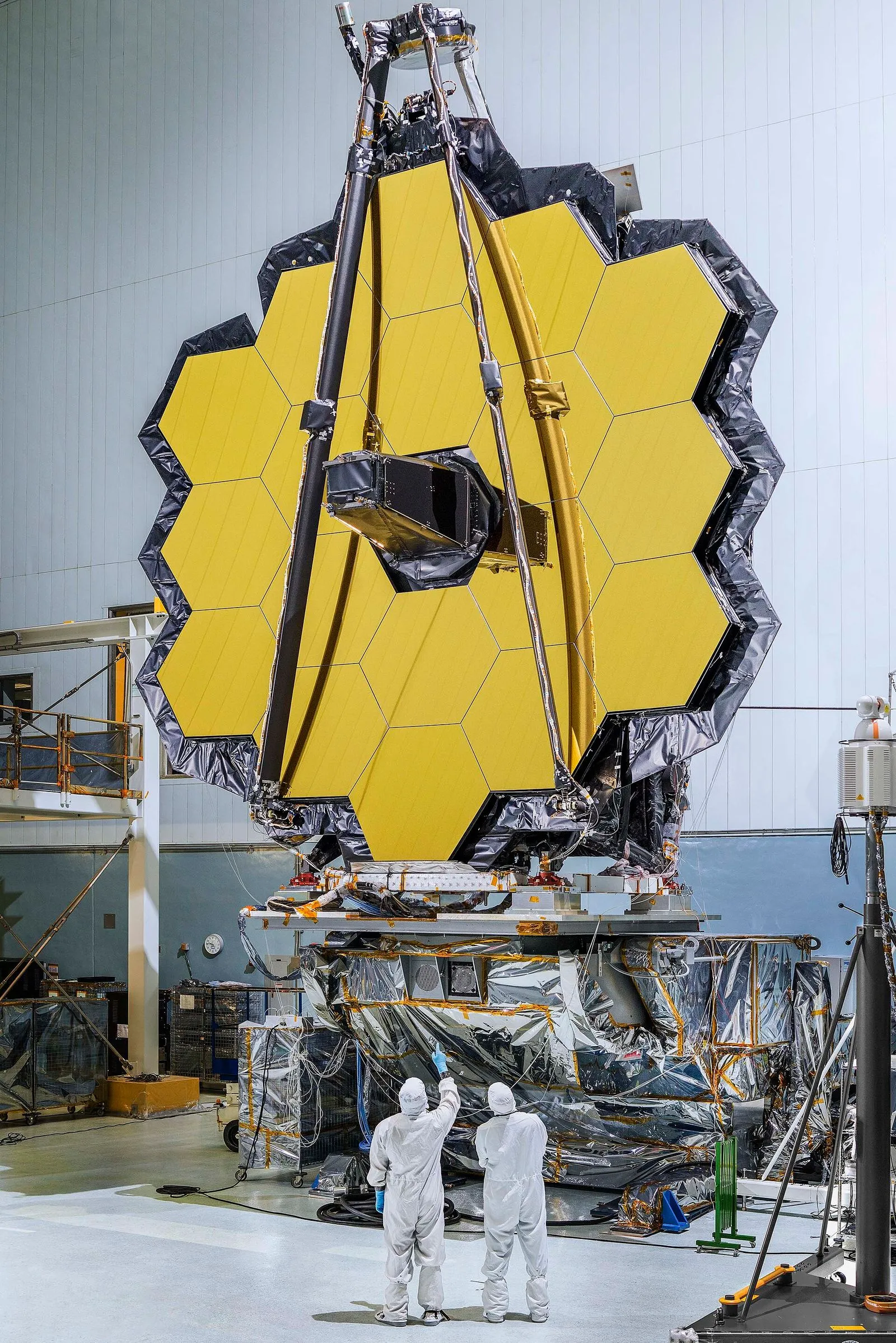
The successor to Hubble — a gold mirror the size of a house, folded into a rocket, unfurled a million miles away to see the first light in the universe.
Robotic campaign ACTIVE
The land
Hubble showed us the universe in visible light. But the most distant objects — the very first galaxies, forming a few hundred million years after the Big Bang — are invisible to it, because the expansion of the universe has stretched their light out of the visible spectrum entirely and into the infrared. To see the dawn of cosmic time, you need an infrared telescope, and a big one, kept extremely cold, parked far from the warmth of the Earth. The James Webb Space Telescope is that machine, and building it took twenty-five years, ten billion dollars, and a run of engineering audacity with almost no room for error.
JWST is the largest and most complex telescope ever flown, and unlike Hubble it is genuinely international — a partnership of NASA, the European Space Agency, and the Canadian Space Agency, launched on a European rocket. It is also the riskiest: too large to fit in any rocket fully assembled, it had to be folded like origami, launched packed up, and then unfold itself perfectly in deep space, through hundreds of steps that could not be tested all together and could never be repaired. That it worked at all is one of the great engineering feats of the era.
Goals
The headline goal is to see the first galaxies — light from the earliest structures in the universe, redshifted deep into the infrared over more than 13 billion years of cosmic expansion. Webb was built to look further back in time than any instrument before it, to the era when the first stars and galaxies switched on, and to watch how the universe assembled itself out of the darkness that followed the Big Bang.
The second goal is to read the atmospheres of other worlds. When an exoplanet passes in front of its star, a little starlight filters through its atmosphere, and Webb's infrared sensitivity can tease apart that light to detect the gases present — water, carbon dioxide, methane. It is the first instrument capable of genuinely characterizing the atmospheres of small, potentially habitable planets, turning the search for life from counting worlds to sniffing their air.
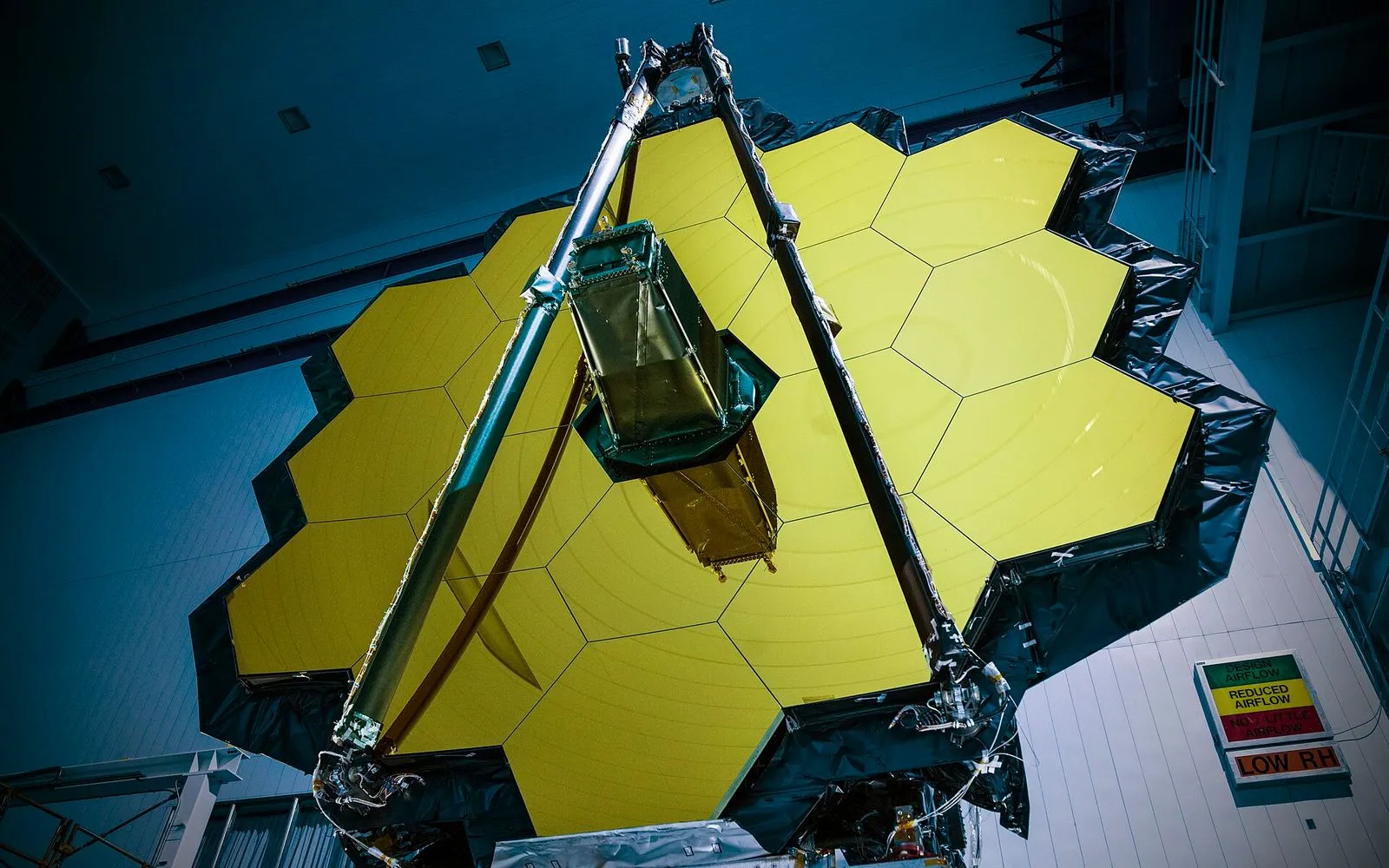
Underneath both goals is a set of brutal engineering requirements: a mirror too big to launch unfolded, a sunshield to keep the whole observatory colder than almost anywhere in the solar system, and a home a million miles from Earth at the L2 point — far enough to stay cold and stable, and far too far for any astronaut to ever visit. Everything had to work the first time, alone, in the dark.
Outcome
After a development so troubled it was nearly cancelled by Congress in 2011, JWST launched on Christmas Day 2021 on an Ariane 5 — and then executed the hardest part flawlessly. Over two weeks it worked through the 344 single points of failure it carried — about 80% of them deployment steps — each of which, if it jammed, would have crippled the mission, with no possibility of a repair crew a million miles out. The sunshield unfolded, the mirror segments locked into place, the telescope cooled — and every single step worked. The launch itself was so precise that the fuel saved roughly doubled the telescope's expected lifetime.
The science began almost immediately and exceeded expectations. Webb's first images, released in July 2022, were the deepest infrared views of the universe ever taken — thousands of galaxies in a patch of sky the size of a grain of sand held at arm's length. Since then it has found galaxies far earlier and more mature than theory predicted, detected molecules in exoplanet atmospheres, peered inside the dusty clouds where stars are born, and forced a genuine rethink of how quickly the early universe assembled. It is doing what Hubble did to a previous generation: rewriting the textbook and redrawing the picture of the cosmos.
The story
The story of JWST is a bet that came within a congressional budget of being killed and paid off completely. For a decade it was the troubled giant of space science — over budget, behind schedule, absorbing money that other missions wanted, and nearly cancelled outright in 2011. The people who defended it were betting that the payoff would justify the pain: that a telescope this ambitious, if it worked, would be worth the decade of delay and the tenfold cost growth. The first images settled the argument. Almost no one now questions that the bet was right.
It is also a story about doing the impossible alone. The defining fact of JWST is that it could not be tested as it would fly and could not be fixed once flown — the sunshield and mirror had to unfold themselves perfectly, the first time, in a place no astronaut could reach. Hubble's flawed mirror was famously repaired by a shuttle crew; JWST had no such safety net. Every one of its hundreds of critical deployments had to succeed on its own, and the fact that they all did is a testament to a level of engineering discipline that borders on the unreasonable.
And it is a genuinely global achievement in a way Apollo never was. Europe built instruments and provided the launch; Canada contributed key sensors; the science is shared across the world's astronomers. JWST belongs to the era of international flagships — too expensive and too hard for any one nation, built by a coalition, and returning a view of the universe that is, in the fullest sense, humanity's rather than any single country's.
What it gave back
JWST's first legacy is already visible: a new view of the early universe, with galaxies found earlier and brighter than models predicted, forcing cosmologists to revisit how the first structures formed. Like Hubble before it, it is the instrument behind a generation's worth of discoveries, and it has decades of operating life ahead of it.
Its second legacy is the characterization of exoplanet atmospheres — the first real capability to analyze the air of small worlds around other stars, and therefore the first serious tool in the search for signs of life beyond Earth. Whatever Webb finds there, it has opened a line of inquiry that will define astronomy for decades.
And its third is a proof of method: that an international coalition can build something too large to launch assembled, deploy it autonomously in deep space, and have it work the first time. That engineering confidence — that the impossible-to-repair can be made reliable enough to trust — is the foundation on which the next generation of even larger space observatories will be built.
What we can learn
The lesson of JWST is that some payoffs are worth an almost unreasonable amount of patience and pain. For most of two decades the telescope was late, expensive, and nearly cancelled; the case for continuing rested entirely on a promise that could not be proven until it flew. The first images vindicated the promise — a reminder that the most transformative projects are often the ones that look, for years, like failures waiting to happen.
The deeper lesson is about engineering without a second chance. JWST could not be tested as flown or repaired once flown, and it still succeeded — because every failure mode was hunted down and designed out in advance, on the ground, over years. It is the ultimate case for rigor over iteration: when you truly cannot fix it later, the only option is to be right the first time, and Webb proved that is achievable, even at staggering complexity.
Missions
- 1996 Conceived planning begins on a 'Next Generation Space Telescope' to succeed Hubble — the start of a 25-year saga of redesigns, delays, and a budget that grew roughly tenfold
- 2011 Nearly cancelled years behind schedule and billions over budget, the program was targeted for cancellation by Congress before being saved — a survival as narrow as any in this atlas
- 2021 Launch on Christmas Day, an ESA-provided Ariane 5 launches JWST flawlessly — so precisely that the telescope saved enough fuel to roughly double its expected lifetime
- 2022 The unfolding over two weeks, 344 single-point-failure steps deploy the tennis-court sunshield and the segmented mirror a million miles from any hope of repair — every one of them worked
- 2022 First images the first full-colour images stun the world — the deepest infrared view of the universe ever taken, galaxies from the dawn of cosmic time
Hardware
- Jwst infrared observatory