NASA · USA · 1989–2003

Galileo
The first spacecraft to orbit Jupiter flew a crippled antenna for over a decade — and still returned the strongest evidence yet that a moon of Jupiter hides an ocean.
Robotic campaign COMPLETED
The land
The Pioneers and Voyagers had flown past Jupiter, each in a matter of hours, and each had left more questions than it answered: hints of an ocean under the ice of Europa, volcanoes on Io, a magnetic field vaster than anything else in the solar system. Flybys could not resolve them. To understand Jupiter and its four great moons — worlds as varied and interesting as planets in their own right — a spacecraft would have to enter orbit and stay for years.
Galileo was built to be that resident, and it had a hard road even before launch. Delayed for years by the Challenger disaster and shifting launch plans, it finally left Earth from the Space Shuttle in 1989 on a slow, looping path — swinging past Venus and twice past Earth to build up speed — that took six years to reach a planet other missions had flown to directly.
Goals
The goal was the first sustained study of the Jupiter system: to orbit the planet, tour its four large moons repeatedly, and turn the Voyagers' tantalising glimpses into understanding. Was there really an ocean under Europa? How did Io's volcanoes work? What drove the largest magnetic field in the solar system? These were questions only an orbiter, passing each moon again and again over years, could answer.
Galileo also carried a second spacecraft: a probe designed to separate on arrival and plunge directly into Jupiter's clouds, measuring the giant planet's atmosphere from the inside as it fell — the first and, so far, only direct sample of the interior of a gas giant.
Outcome
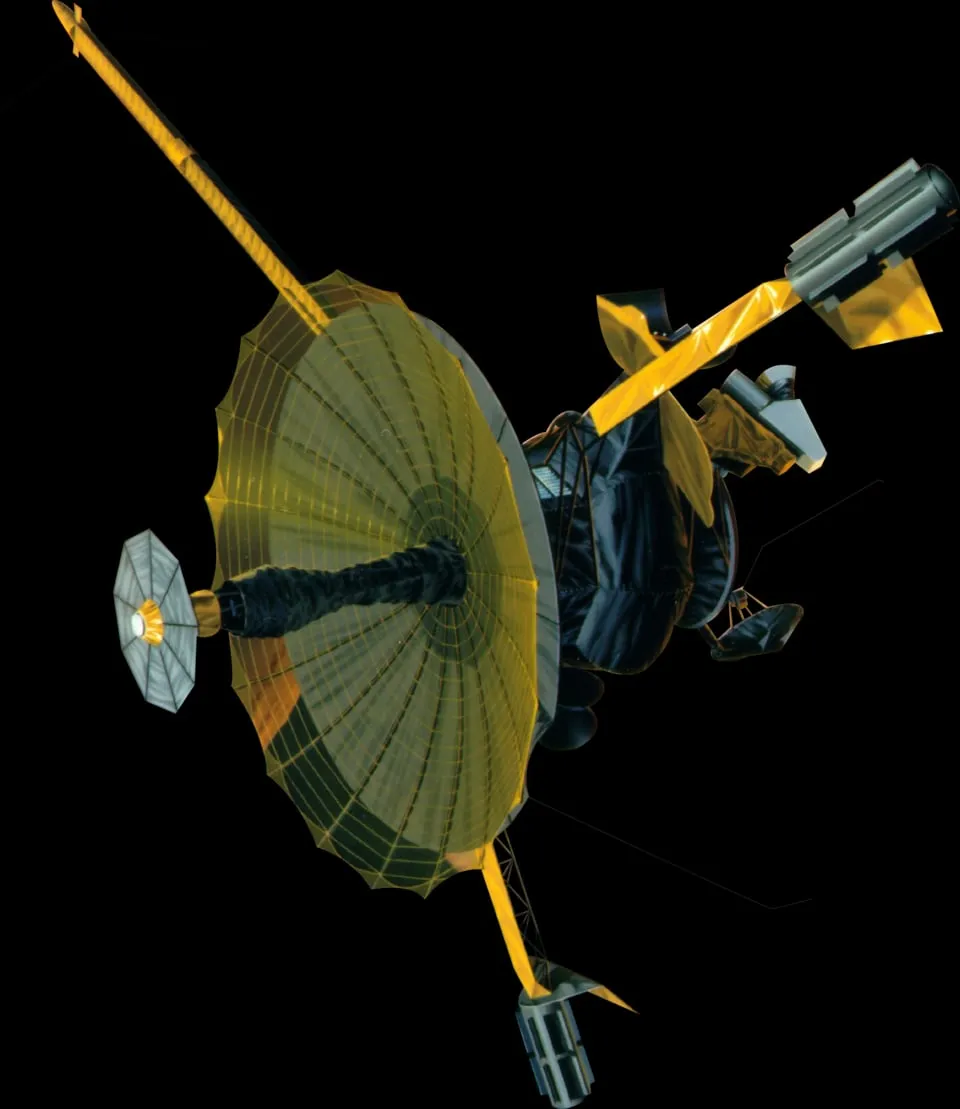
Then the mission nearly broke. In 1991, on the way to Jupiter, Galileo's main antenna failed to open — it stuck half-furled, like an umbrella that would not deploy, cutting the spacecraft's data rate to a tiny fraction of what was planned. The mission should have been crippled. Instead, engineers rewrote its software from Earth, teaching the distant spacecraft to compress its data far more aggressively and dribble it home through a small backup antenna. Most of the science was saved over a link thousands of times slower than intended.
It arrived at Jupiter in December 1995, released its probe into the clouds, and settled into orbit — the first spacecraft ever to do so. Over the nearly eight years it toured the moons dozens of times, and its greatest discovery emerged slowly from that persistence: the way Jupiter's magnetic field draped around Europa could only be explained by a salty, conducting ocean of liquid water beneath the moon's ice. It also mapped Io's relentless volcanism and found signs of a magnetic field generated inside the moon Ganymede.
In 2003, low on fuel, Galileo was deliberately flown into Jupiter and destroyed — the same choice Cassini would later make at Saturn — to be certain that the spacecraft could never one day crash onto Europa and contaminate the ocean it had done so much to reveal.
The story
The story of Galileo is a mission rescued from disaster by ingenuity. The stuck antenna could have ended it; the spacecraft was designed around a high-speed link that no longer existed. That Galileo returned most of its science anyway — through a backup antenna never meant to carry the load, over software written and uploaded after launch — is one of the great salvage jobs in the history of spaceflight, and a reminder that a mission's outcome is decided as much by the people flying it as by the hardware that flew.
Its most important discovery reframed a moon. Before Galileo, Europa's ocean was a hypothesis drawn from a few Voyager images; after Galileo, it was the leading explanation for hard magnetic data gathered on pass after pass. A frozen moon of Jupiter joined Saturn's Enceladus as a place where liquid water — and the possibility of life — hides beneath the ice. Galileo did not see the ocean; it made the case for it undeniable, and pointed the next generation of missions at Europa.
And, like Cassini after it, Galileo ended by destroying itself to protect what it had found. A spacecraft that had spent nearly eight years arguing that Europa might be habitable could not be allowed to become the thing that seeded it with Earth life. Its final act was to fall into Jupiter — the giant planet swallowing the robot that had finally understood its moons.
What it gave back
Galileo's first legacy is Europa. Its data turned a subsurface ocean from speculation into the leading model, making Europa one of the two or three most compelling places in the solar system to search for life — and the direct reason a dedicated mission, Europa Clipper, was later built to follow up.
Its second is the Jupiter system as a whole: the first sustained study of the giant planet, its atmosphere sampled from within, its magnetic field mapped, and its four great moons transformed from Voyager glimpses into understood worlds across nearly eight years in orbit.
Its third is a demonstration of resilience — that a mission can lose its central capability and still succeed if the people flying it are inventive enough. Galileo's software rescue is a permanent case study in salvaging a spacecraft that should, by rights, have been lost.
What we can learn
The lesson of Galileo is that a mission is not finished when its hardware fails. The stuck antenna removed the capability the whole spacecraft had been designed around — and the mission still succeeded, because its operators rewrote what the machine did rather than mourning what it could no longer do. When the plan breaks, the question is not what was lost but what can still be done with what remains; the difference between a dead mission and a great one is often the answer to that.
The deeper lesson is that patience turns hints into knowledge. Europa's ocean was invisible in any single pass; it emerged only from the accumulated weight of many, gathered over years in orbit. The most important discoveries are frequently not seen but built — assembled measurement by measurement, until a hypothesis becomes the only thing that fits the data.
Missions
- 1991 The stuck antenna the main antenna failed to open fully; the mission was rescued by new data-compression software beamed up to the spacecraft, salvaging most of the science over a trickle-speed link
- 1995
 the first spacecraft to orbit Jupiter — nearly eight years studying the giant planet and its major moons up close
 - 1995 The atmospheric probe on arrival, Galileo released a probe that plunged into Jupiter's clouds — the first and only direct sample of a giant planet's atmosphere
- 1996 Europa's hidden ocean Galileo's magnetic and imaging data made the strongest case yet that an ocean of liquid water lies beneath the ice of Jupiter's moon Europa
- 2003 The deliberate end out of fuel, Galileo was flown into Jupiter on purpose, to be certain it could never crash onto Europa and contaminate its ocean