NASA · USA · 1997–2017



Cassini
A bus-sized robot spent thirteen years orbiting Saturn — and found, on a moon nobody was watching, an ocean that could hold life.
Robotic campaign COMPLETED
The land
By the 1990s Saturn had been seen three times, and only in passing: Pioneer 11 and the two Voyagers had each swept through the system in a matter of hours, returning tantalising glimpses of a ringed world with dozens of moons and a giant, haze-shrouded moon, Titan, whose surface no camera could pierce. A flyby can photograph a place; it cannot live there. To understand Saturn — its rings, its weather, its improbable family of moons — a spacecraft would have to stop and stay.
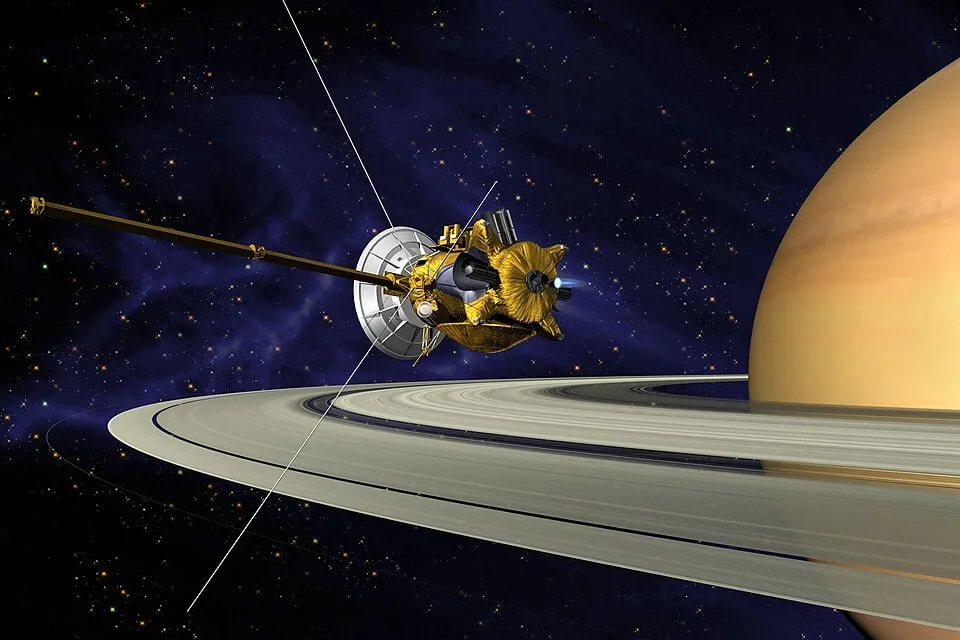
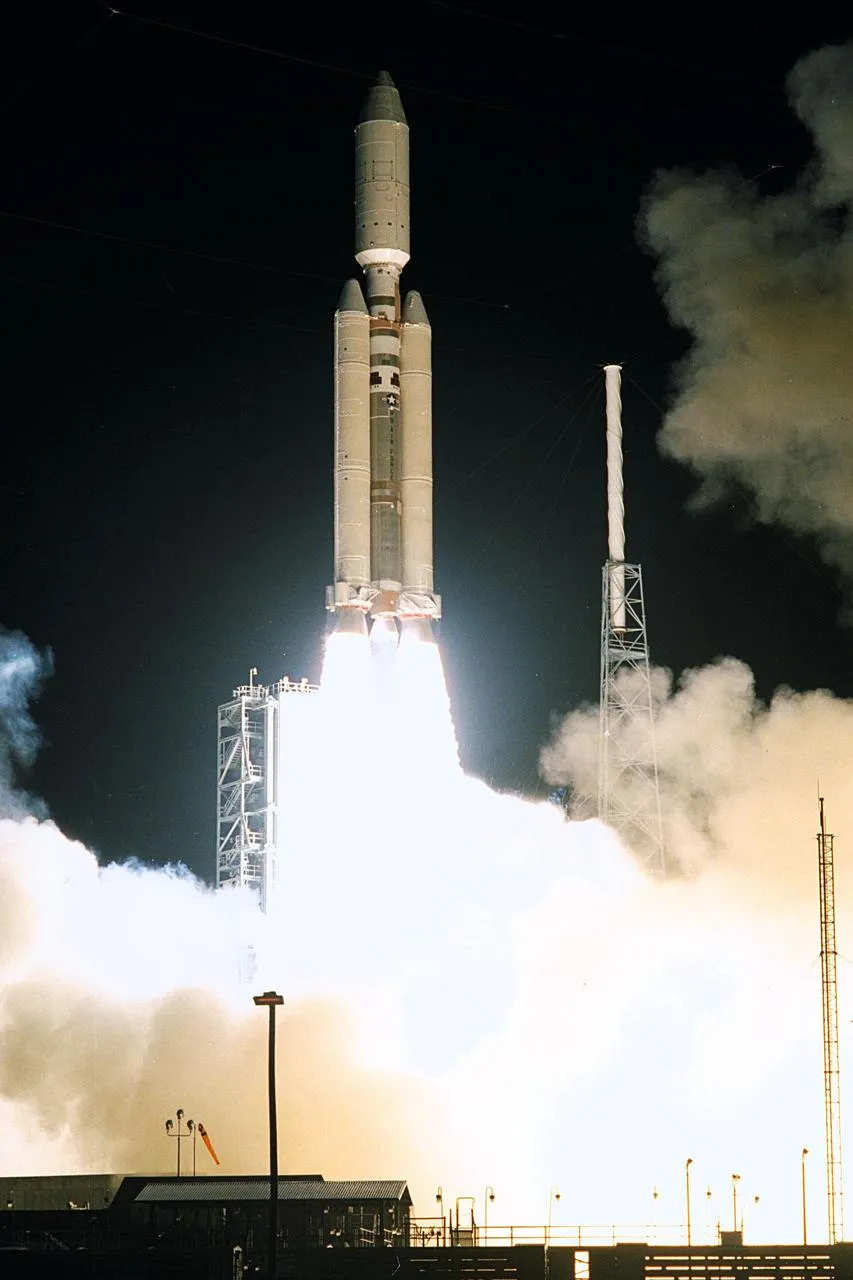
Cassini was built to do exactly that, and it was built by a coalition: NASA supplied the orbiter, the European Space Agency supplied a lander called Huygens to drop through Titan's haze, and Italy built its high-gain antenna. It launched in 1997 as one of the largest and most capable interplanetary craft ever flown — a seven-year, three-and-a-half-billion-kilometre cruise ahead of it just to reach the planet it was designed to study.
Goals
The primary goal was to become Saturn's first resident: to enter orbit and stay for years, studying the planet's atmosphere, its rings, its magnetic field, and its moons across the slow turn of the Saturnian seasons — the sustained, patient science that no flyby can do. Chief among the targets was Titan, the one moon large enough to hold a thick atmosphere, and the great mystery of the outer solar system.
The second goal belonged to Huygens: to descend through Titan's orange haze and land — or splash — on a surface no one had ever seen, and find out whether the moon really had the lakes and rivers of liquid methane that theory predicted. It was a single, one-way attempt at the most distant landing ever tried.
Outcome
Cassini reached Saturn in 2004 and settled into orbit. Months later it released Huygens, which parachuted through Titan's haze in January 2005 and returned the first pictures from the surface of a moon in the outer solar system: a dim, orange plain scattered with rounded pebbles of water ice, shaped by rivers of liquid methane. It remains the only landing humanity has ever made beyond the asteroid belt.
The orbiter's own great discovery came from a moon almost no one had expected to matter. Passing tiny Enceladus, Cassini found towering jets of water ice and vapour erupting from cracks at its south pole — proof of a global ocean of liquid water beneath the ice, warm and salty and laced with organic molecules. A frozen speck five hundred kilometres across turned out to be one of the most promising places in the solar system to look for life.
Cassini worked for thirteen years, long past its planned mission, until it ran low on fuel. Rather than risk it eventually crashing into Enceladus or Titan and contaminating them with Earth microbes, mission planners chose a deliberate end: twenty-two dives through the unexplored gap between Saturn and its rings, returning data to the last, and then a final plunge into the planet's atmosphere in September 2017, transmitting until it burned up.
The story
The story of Cassini is what patience buys. The Voyagers had shown Saturn in a day and moved on; Cassini stayed for over a decade, and almost everything it found that mattered came from being there long enough to watch — a storm wrap the whole planet, a season turn, a moon pass close enough on the four-hundredth orbit to reveal what the first flyby had missed. Its discoveries were not lucky glances but the reward of persistence.
Its most consequential find rewrote where we look for life. Before Cassini, the search for habitable places focused on Mars and the warm inner solar system. Enceladus — small, frozen, far from the Sun — should have been dead. Instead it was venting the ingredients of life into space, kept liquid by the flexing pull of Saturn's gravity. Cassini turned the outer solar system, long thought a frozen wasteland, into a plausible home for oceans, and for whatever oceans might hold.
And its ending was a moral choice as much as an engineering one. A spacecraft that had discovered two possibly habitable ocean worlds could not be allowed to become the thing that contaminated them. So its operators flew it into Saturn on purpose, sacrificing the machine to protect the very places it had found — planetary exploration taking responsibility for its own reach.
What it gave back
Cassini's first legacy is Saturn itself, transformed from a world seen in passing into the best-understood planet in the outer solar system — its rings, its weather, its magnetic field, and its dozens of moons mapped across thirteen years of continuous observation that no future mission is scheduled to repeat.
Its second is Enceladus and Titan: two ocean worlds and one methane world moved, by Cassini's data, to the front rank of places worth returning to in the search for life. Every proposal to hunt for biology in the outer solar system now begins with what Cassini found.
Its third is the model of the mission itself — a genuinely international flagship, NASA and Europe flying one spacecraft for two decades, that demonstrated how much more a patient orbiter returns than a fast flyby, and set the template for the long-duration missions that followed.
What we can learn
The lesson of Cassini is that staying beats passing through. The same planet the Voyagers characterised in hours yielded its deepest secrets — the ocean of Enceladus, the methane cycle of Titan — only to a spacecraft willing to spend thirteen years in orbit. For the hardest questions, presence over time is worth more than any single brilliant glance.
The deeper lesson is that reach carries responsibility. Cassini ended by flying itself into Saturn to protect the ocean moons it had discovered — a recognition that the power to visit a possibly living world comes with a duty not to poison it. Capability without that restraint is not exploration; it is trespass.
Missions
- 2004
 spent thirteen years in orbit at Saturn — the only spacecraft ever to do so — mapping the rings, the moons, and the storms in detail no flyby could reach
 - 2005 Huygens lands on Titan the European Huygens probe parachuted onto Titan in January 2005 — the first and only landing anywhere in the outer solar system
- 2005 The geysers of Enceladus Cassini found jets of water ice erupting from the south pole of the tiny moon Enceladus, evidence of a global ocean beneath its ice — one of the most promising places to look for life
- 2017 The Grand Finale out of fuel, Cassini was flown between Saturn and its rings twenty-two times and then deliberately plunged into the planet, to be sure it could never contaminate the ocean moons