ISRO · India · 2018–now
Gaganyaan
India's bid to launch its own people — the crewed program that would make it the fourth nation with independent human spaceflight.
Crewed campaign PLANNED
The land
India has reached the Moon and Mars with robots, on famously small budgets, and earned a place among the world's serious space powers. But one capability has remained out of reach: launching its own people. Human spaceflight is a different order of difficulty from robotic exploration — a single failure costs lives, not just a mission — and only three nations have ever done it independently. Gaganyaan — Sanskrit for "sky craft" — is India's program to become the fourth.
It is a deliberate step up the ladder ISRO has been climbing for decades. The agency that reached Mars on its first try and landed at the lunar south pole is now building the far harder capability of keeping human beings alive in orbit and bringing them safely home — a crew capsule, a human-rated launcher, a life-support system, an escape system, and an astronaut corps. Gaganyaan is the program where India's robotic confidence meets the unforgiving standard of human safety.
Goals
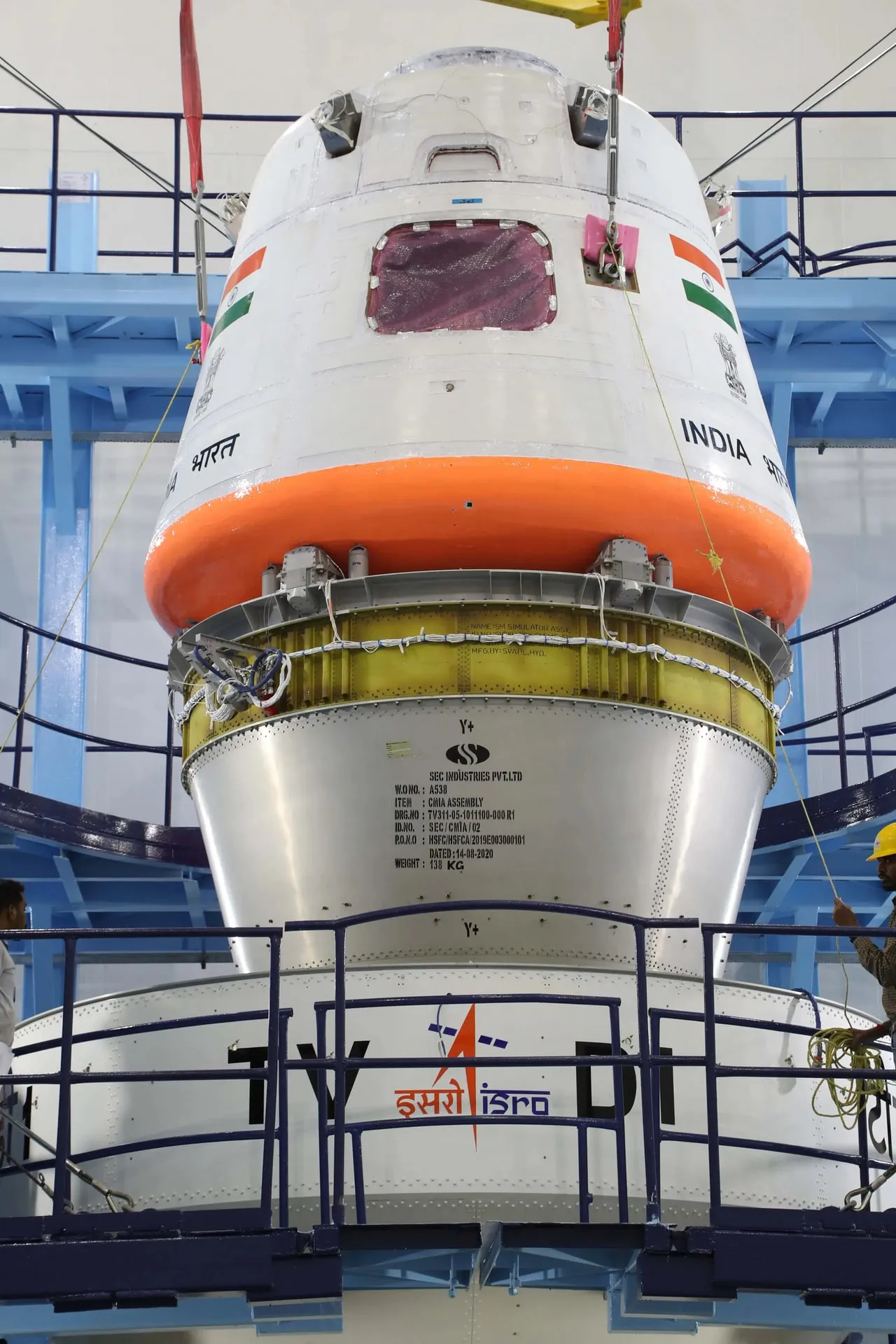
The core goal is straightforward and enormous: fly a small crew of Indian astronauts to low Earth orbit on an Indian rocket, keep them alive there for a few days, and return them safely. Doing so requires mastering the specific, life-critical technologies of human spaceflight — a pressurized crew capsule, a reliable life-support system, a human-rated version of India's heavy launcher, and above all a crew-escape system that can pull the capsule clear of a rocket failing on the pad or in flight.
The longer-term goal is a foundation, not a single flight. India has stated ambitions for its own space station and eventually crewed lunar missions, and none of that is possible without first mastering basic human spaceflight. Gaganyaan is the prerequisite — the program that turns India from a nation that explores with robots into one that can send its own people, the gateway to everything crewed that follows.
Outcome
Gaganyaan is still ahead of its first crewed flight, working methodically through the same prove-it-first discipline that defined Chandrayaan and Mangalyaan. It has run uncrewed tests, including a 2023 flight that demonstrated the crew-escape system pulling the capsule away from its rocket — the single most important safety capability of any human program. Uncrewed orbital test flights and a robotic humanoid passenger will precede any human launch; the first crew is targeted for 2027.
The outcome will be measured not just by reaching orbit but by doing it safely, on an ISRO budget, without the years of fatal accidents that scarred the early US and Soviet programs. India is attempting to join the human-spaceflight club having watched everyone else do it first — and, as with its robotic firsts, is betting that patience and frugality can deliver a capability the pioneers paid for in lives.
Because the program is not yet complete, its story is still being written. But its trajectory is clear: India has methodically acquired every other deep-space capability it set out to build, and Gaganyaan is the current rung on that ladder — the hardest one, and the one that would place India among the very small group of nations that can put a human into space on their own.
The story
The narrative of Gaganyaan is a nation stepping deliberately from robots to people. Every capability India built before it — reaching orbit, navigating to other worlds, landing softly, returning samples of experience — was preparation for the one it could not shortcut: keeping humans alive in space. Gaganyaan is ISRO applying its signature method, incremental and frugal and unhurried, to the highest-stakes problem in spaceflight, where the usual tolerance for failure does not apply.
It is also a program shaped by watching others. India comes to human spaceflight six decades after Gagarin, with the entire history of the US, Soviet, and Chinese programs to learn from — their triumphs and, more valuably, their disasters. Like China before it, India is optimizing not for being early but for arriving safely, engineering out in advance the failure modes that killed earlier crews. Being last to this capability is, in the specific domain of human safety, an advantage.
And it carries national weight beyond the engineering. An Indian astronaut in an Indian spacecraft, launched from Indian soil, is a milestone of a kind that resonates far past the space community — a marker of technological arrival for the world's most populous nation. Gaganyaan is a science-and-engineering program that is also, unmistakably, a statement about India's place among the powers that can reach space on their own.
What it gave back
Gaganyaan's legacy, once it flies, will be India's entry into the small club of nations with independent human spaceflight — a capability that cannot be bought or borrowed, only built, and that reshapes a country's standing in space overnight.
Its deeper legacy is as a foundation. Every ambition India has voiced beyond it — a national space station, crewed lunar missions, a long-term human presence in orbit — depends on the basic human-spaceflight capability Gaganyaan is built to establish. It is the doorway through which all of India's crewed future must pass.
And it extends the multipolar shift that Chandrayaan and Mangalyaan began. As India joins Russia, the US, and China in independent human spaceflight, the capability to send people to space becomes genuinely distributed — no longer the preserve of the Cold War powers, but shared among a widening circle of nations.
What we can learn
The lesson Gaganyaan is testing is whether the frugal, incremental method that carried India to the Moon and Mars can be extended to the one domain that punishes shortcuts hardest: human safety. Robotic missions can fail and teach; a crewed one that fails kills. Gaganyaan is the case study in whether ISRO's discipline scales to a problem where the margin for error is zero.
The deeper lesson is that in human spaceflight, arriving last can be a form of wisdom. India comes to crewed flight with every predecessor's accidents to study, and the chance to engineer out in advance the failures that others discovered fatally. Being decades late costs it prestige it does not seem to want; what it buys, if the method holds, is astronauts who come home.
Missions
- 2018 Announced India commits to flying its own astronauts on its own rocket — the goal that would make it the fourth nation with independent human spaceflight
- 2023 Test Vehicle abort the first flight test demonstrates the crew-escape system, which must pull the capsule clear of a failing rocket — the safety capability a crewed program is built around
- 2027 First crewed flight the planned debut of an Indian crew in an Indian spacecraft — targeted for early 2027, joining Russia, the US and China as independent human spaceflight powers
Hardware
- Gaganyaan crew spacecraft