ISRO · India · 2008–now
Chandrayaan
India's Moon program — it found the water that changed how we see the Moon, then became the first nation ever to land near the south pole.
Robotic campaign ACTIVE
The land
For most of the space age, the Moon was thought to be bone dry — a dead, airless rock with nothing useful on its surface. That assumption was overturned by a spacecraft from a country that had never been to the Moon before. Chandrayaan-1, India's first lunar mission — launched in 2008 — carried NASA/JPL's Moon Mineralogy Mapper (M3) instrument, which detected water molecules bound into the lunar soil across broad, mostly higher-latitude regions of the surface; the findings were published in 2009. It was one of the most consequential discoveries in modern planetary science, and it came from an ISRO orbiter working on a fraction of NASA's or ESA's budget.
Chandrayaan — Sanskrit for "Moon craft" — is the program that announced India as a genuine deep-space power, not a regional one. It is defined by two things: doing world-class science cheaply, and a refusal to be stopped by failure. Its second mission crashed a lander on the Moon in front of a watching nation; its third went back four years later and succeeded, landing where no one ever had — near the lunar south pole, the most sought-after real estate in the solar system.
Goals
The scientific goal from the start was the Moon's composition and, above all, its water. Chandrayaan-1 set out to map the surface and search for water and minerals; its success made the later goal obvious and urgent — reach the south pole, where permanently-shadowed craters are thought to hold water ice, the resource that could one day fuel and sustain a lunar base. India aimed its program directly at the most valuable question about the Moon.
The engineering goal grew mission by mission: first to orbit the Moon and release an impactor (Chandrayaan-1), then to soft-land a rover (Chandrayaan-2 and -3). Soft-landing on the Moon is brutally difficult — most attempts by most nations have failed — and doing it at the rough, poorly-lit south pole is harder still. India's goal was to master that landing, and to do it on an ISRO budget that made every rupee count.
Outcome
The outcomes bracket the whole arc of the program. Chandrayaan-1 (2008) carried NASA's M3 instrument, whose data — published in 2009 — revealed lunar water, a genuinely field-changing result. Chandrayaan-2 (2019) was a partial heartbreak: its orbiter reached the Moon and still operates, returning excellent data, but its Vikram lander lost control in the final moments and crashed, watched live by a nation that had dared to hope. Then Chandrayaan-3 (2023) returned and landed softly near the south pole — the first spacecraft ever to do so, and the achievement that made India the fourth country to land on the Moon, days after a Russian attempt at the same region failed.
The contrast with the budgets involved is the part that stunned the world. India reached the Moon, found its water, and landed at its south pole for costs that were a small fraction of comparable Western missions — a demonstration that frontier lunar exploration is not the exclusive preserve of the richest agencies. ISRO turned constraint into a discipline, and delivered firsts that far larger programs had not.
Chandrayaan-3's success also carried a weight beyond science. It landed at a moment when the south pole had become a contested goal — Russia's Luna-25 had crashed attempting the same thing that same month — and India's soft touchdown was a national triumph celebrated across the country, and a signal that the emerging space powers now reach places the old ones are still struggling toward.
The story
The story of Chandrayaan is a country teaching itself to land on another world in public, and refusing to quit when it went wrong. Chandrayaan-2's crash was not hidden or downplayed; it happened live, and the head of ISRO was shown grieving it on national television. Four years later the same program came back and succeeded — the same engineers, the same objective, the lessons of the failure engineered into the fix. It is the clearest recent example of a space agency turning a very visible defeat into a very visible victory.
It is also a story about cost. ISRO's genius is doing profound things cheaply — reaching the Moon and Mars for budgets that would barely fund a study elsewhere. That frugality is partly necessity and partly philosophy: a deliberate engineering culture of simplicity, reuse of proven hardware, and ruthless prioritization. Chandrayaan proves that the price of admission to deep space has fallen far enough that a determined nation of modest means can hold genuine firsts.
And it is a story about who the Moon belongs to now. For decades lunar exploration was a two-superpower affair, then a quiet scientific one. Chandrayaan, alongside China's program, Japan's SLIM, and a wave of others, marks the arrival of a genuinely multipolar Moon — where the first soft landing at the south pole was made not by the United States, Russia, or China, but by India.
What it gave back
Chandrayaan's first legacy is scientific and permanent: providing the platform from which NASA's M3 instrument detected water on the Moon — data published in 2009, which reframed the Moon from a dead rock into a place that might sustain a human presence and underlies every current plan to return, including Artemis and China's.
Its second legacy is the first soft landing near the lunar south pole, the region every future lunar program is aiming for. India got there first, giving it a genuine claim to leadership at the most important destination on the Moon and hard-won landing experience that later missions will build on.
And its third is a demonstration, watched worldwide, that frontier space is now affordable to more than the traditional powers. ISRO's costs reset expectations for what lunar exploration has to cost — an example the next generation of emerging space nations is already following.
What we can learn
The lesson of Chandrayaan is that a public failure, fully owned and learned from, can become the foundation of a greater success. Chandrayaan-2's crash could have ended the program's ambition; instead it became the data that made Chandrayaan-3's historic landing possible. The willingness to try again, in the same public eye that watched the failure, is the whole story.
The deeper lesson is that cost is a form of capability. By doing profound exploration cheaply, ISRO did not merely save money — it made a class of missions possible for a nation that could never have afforded them at Western prices, and reset what the rest of the world believes deep-space exploration must cost. Frugality, pursued as engineering discipline, is itself a kind of power.
Missions
- 2008 India's first Moon mission — its impactor and instruments find clear evidence of water molecules across the lunar surface, a discovery that reshaped how we understand the Moon
- 2019 Chandrayaan-2 the orbiter succeeded and still works, but the Vikram lander crashed on final descent — a public, painful near-miss at the south pole
- 2023
 the return: Vikram lands softly near the lunar south pole — the first spacecraft ever to do so, making India the fourth nation to land on the Moon
Hardware
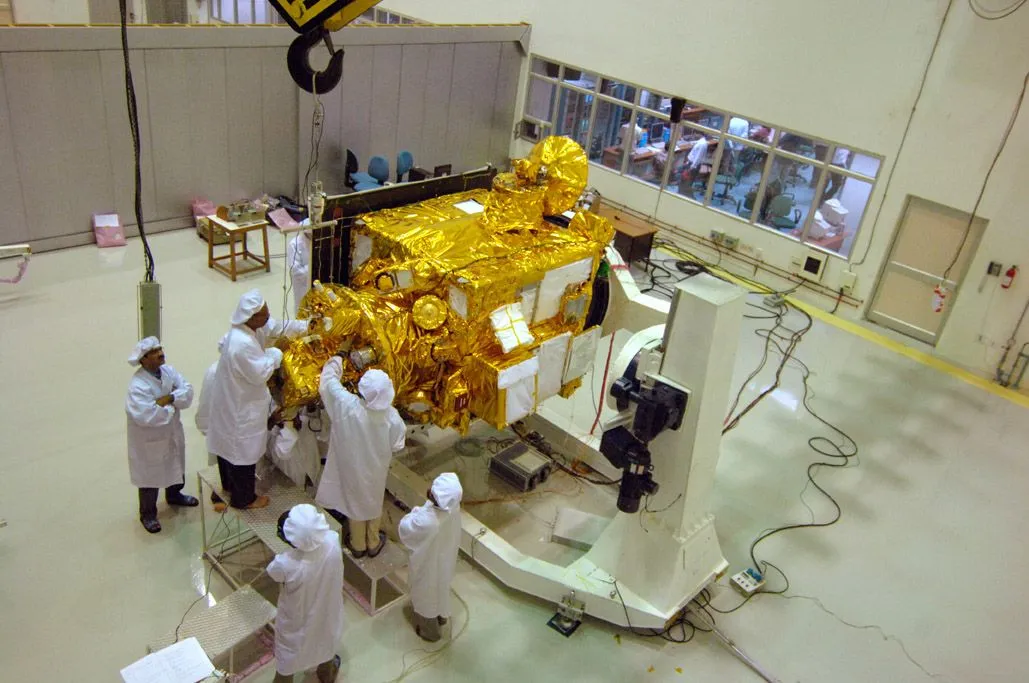
- Chandrayaan1 lunar orbiter