Solar Power Budget
How much electricity the solar arrays generate — the upstream constraint on every system the crew can run.
101 · zoom in
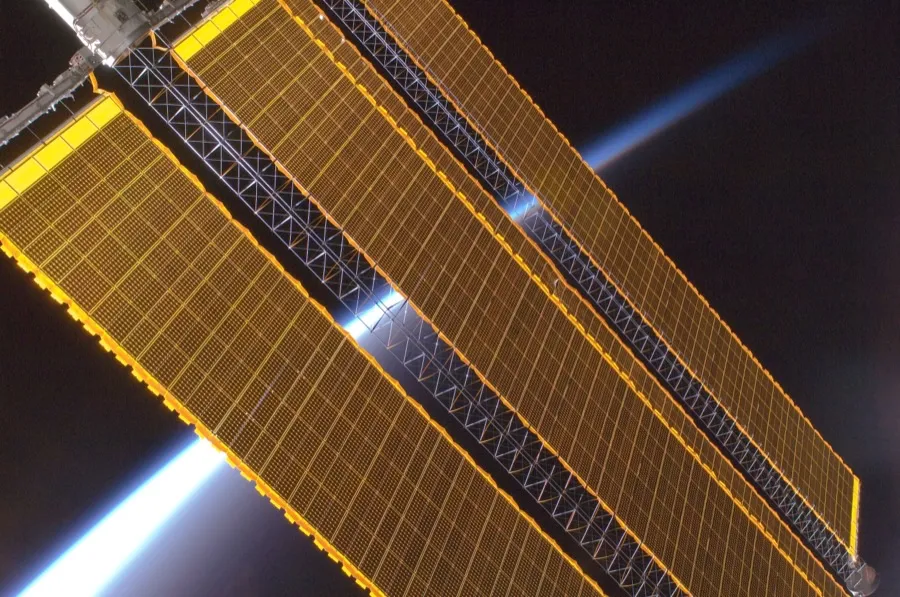
A space station runs on solar electricity. The solar wings run the length of the ISS's ~109 m truss — bigger than a football field — because everything else depends on the watts they pull from sunlight: life support, communications, scientific instruments, the crew's exercise machine, the toilet's air-flow fan.
The eight original 35 m × 12 m ISS arrays delivered ~160 kW peak sunlit at beginning of life, derated with age; augmented by six iROSA roll-out arrays (covering six of the eight original wings, each adding >20 kW), total installed generation capacity reached ~215 kW. Orbit-average power delivered to loads — accounting for the ~0.6 sunlit fraction and battery/regulation losses — is roughly 84–120 kW. Tiangong runs lighter at about 27 kW peak — fewer crew, fewer experiments, simpler thermal load.
Power dictates ambition. Want to run a centrifuge biology experiment? Plug it in — it'll cost 1.5 kW. Want to add ten more racks of payloads? You need a power budget, and either you grow the array (expensive — new mission) or you load-shed something else.
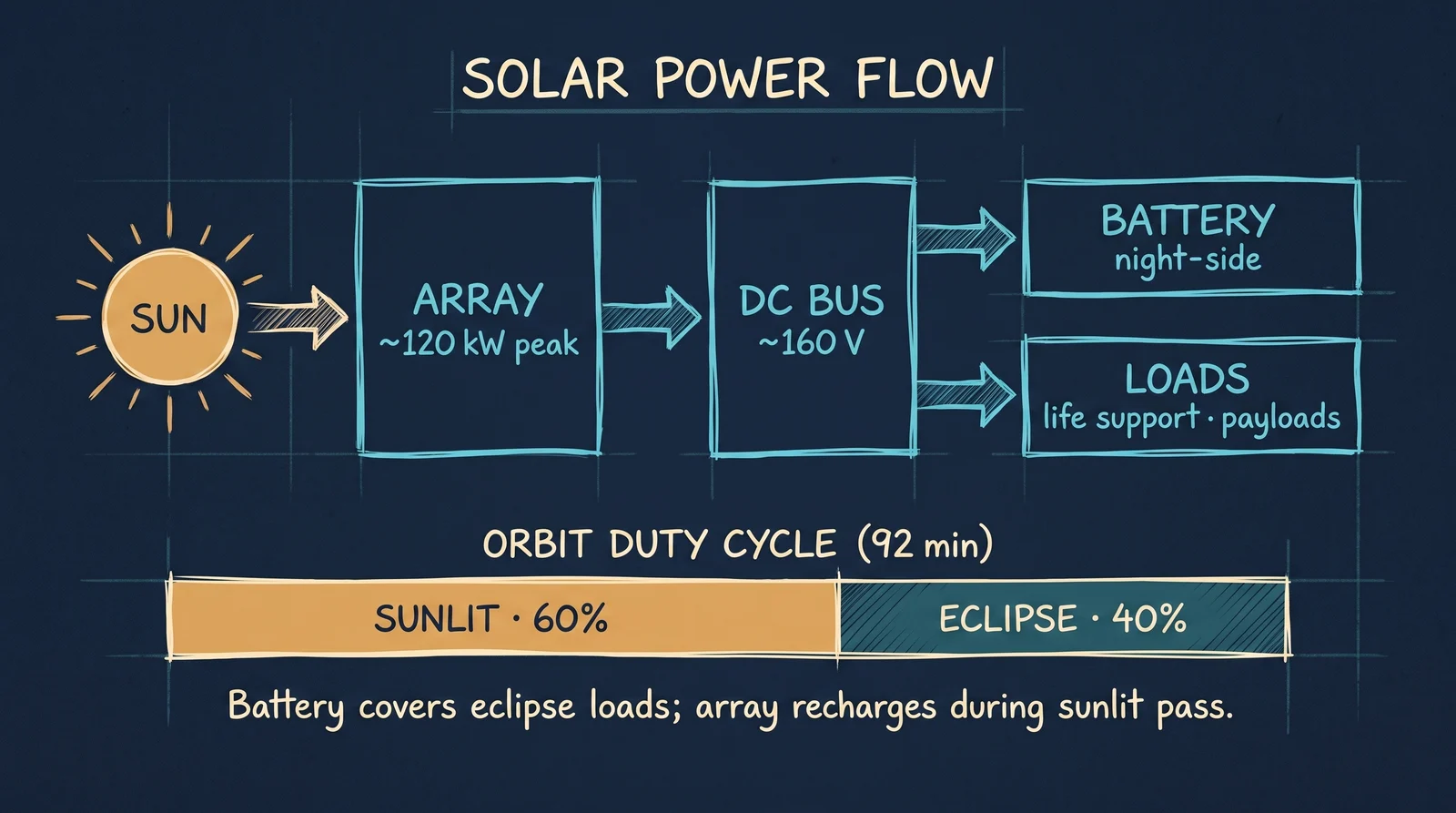
Solar power budget = peak generated power × duty cycle (sunlit fraction of orbit) × downstream efficiency (battery + regulator losses). For LEO stations the duty cycle is about 0.6 — roughly 35 minutes sunlit out of every 92-minute orbit.
ISS solar arrays: 8 main IEA wings (4× P3/P4, P6 + 4× S3/S4, S6) at ~160 kW peak BOL, derated to ~84 kW EOL at 15 years. Six iROSA roll-out arrays (covering 6 of the 8 original wings), each adding >20 kW, bring total installed generation to ~215 kW sunlit. Orbit-average power delivered to loads (×~0.6 sunlit fraction, minus storage/regulation losses) ≈ 84–120 kW.
Tiangong solar arrays: 4 wings on Tianhe (2 retractable each side) plus 4 large wings on Wentian and Mengtian. Total ~30 kW BOL × duty cycle = ~18 kW continuous, with 27 kW peak during sunlit pass.
Battery storage: ISS uses lithium-ion battery ORUs (orbital replacement units) at ~50 kWh capacity per pair. Each battery covers one main array's night-side load. Tiangong uses similar Li-ion banks, sized for the smaller load.
Mir, by contrast, peaked at ~30 kW from 1500 m² of array — comparable on a per-volume basis to Tiangong but with older nickel-cadmium battery storage that needed deeper rebuilds over its 15-year life.