Departure-Window Axis
When you launch — running across the X-axis, typically a four-year span sampled daily.
101 · zoom in
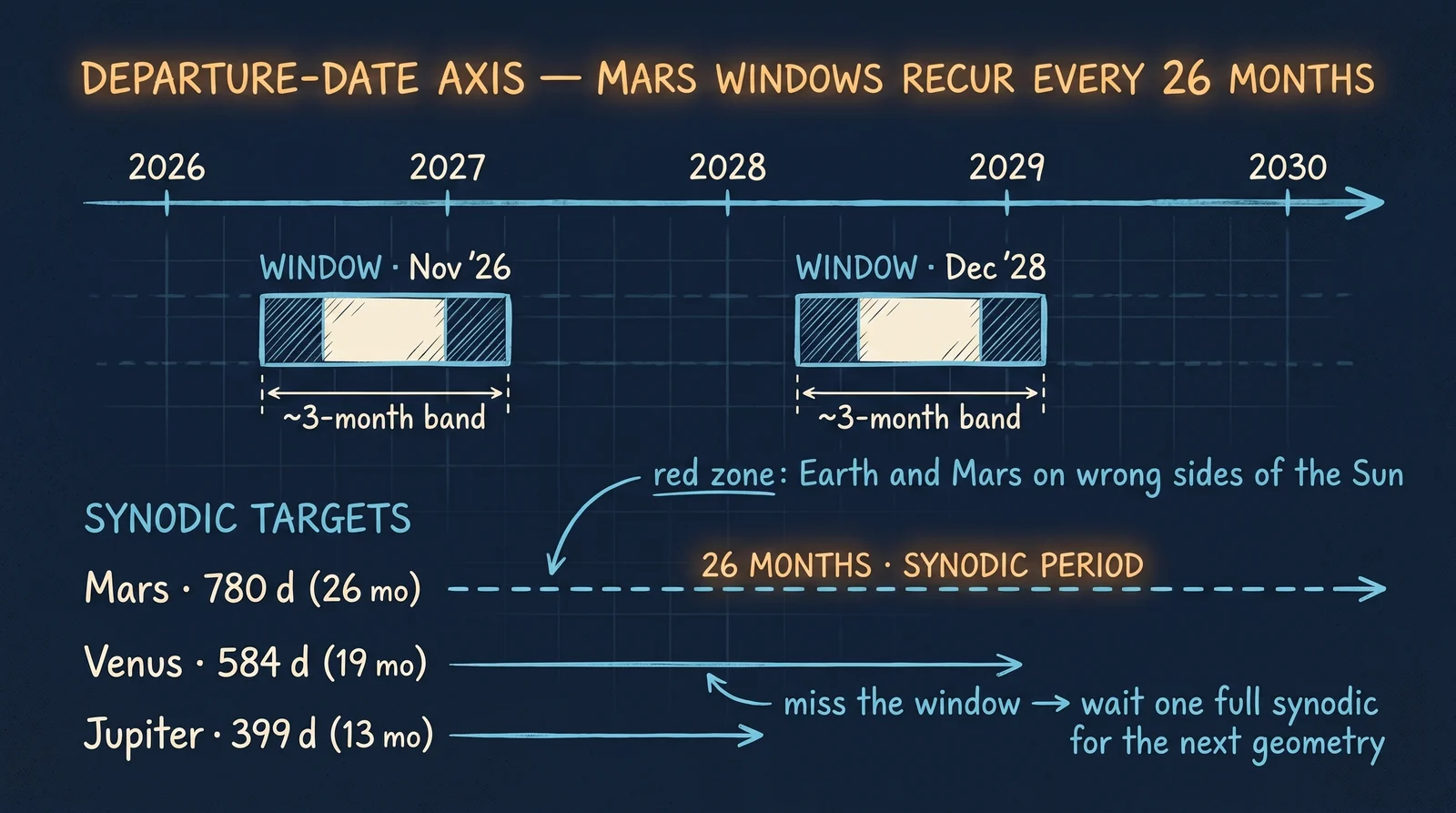
Read the porkchop like a calendar. The horizontal axis — left to right — is the date you leave Earth. Each pixel column is a different launch day. Orrery samples at one-day resolution across about four years; that's enough to capture two full synodic cycles for Mars (the ~26-month cycle fits roughly twice in four years), which is enough to see the launch-window pattern repeat.
Look across the row of cheap-cost cells (the cool teal lobe) and you can read off, on the calendar, exactly when the launch windows are. For Mars they're roughly every 26 months. For Venus every 19. For Jupiter every 13. Each cheap zone is one window — outside of those zones, the calendar is fighting you.
When you scrub the launch-year selector in /plan, you're sliding the X-axis. Different year, different window placement, but the underlying physics is the same. This is why mission scheduling is calendar-driven: the cheap zones don't move just because we have a deadline.
The X-axis tells you when you leave Earth. Each pixel column is a different launch date — for Orrery's plots, sampled at one-day resolution across roughly four years. Why a four-year span? Because the Earth-Mars synodic period is ~26 months; four years captures roughly two full Mars windows. For Venus (~19 months) or Jupiter (~13 months) the same span fits more windows — the four-year width is calibrated for Mars-class planning.
Read the X-axis like a calendar. The cheap-cost lobes (the porkchop's 'pork') sit at predictable intervals. For Mars: every ~26 months. For Venus: every ~19 months. For Jupiter: every ~13 months (Jupiter moves slowly enough that the synodic period is close to Earth's year).
On `/plan` the X-axis label is `DEPARTURE WINDOW · 2026 — 2030`. The literal calendar dates appear in the tooltip when you hover.
SEE IN THE APP
- /plan X axis on the porkchop is DEPARTURE WINDOW