Kepler's Laws · 1609–1619
Tycho Brahe's lifetime of naked-eye Mars data, distilled by Kepler into the three rules every orbit obeys.
101 · zoom in
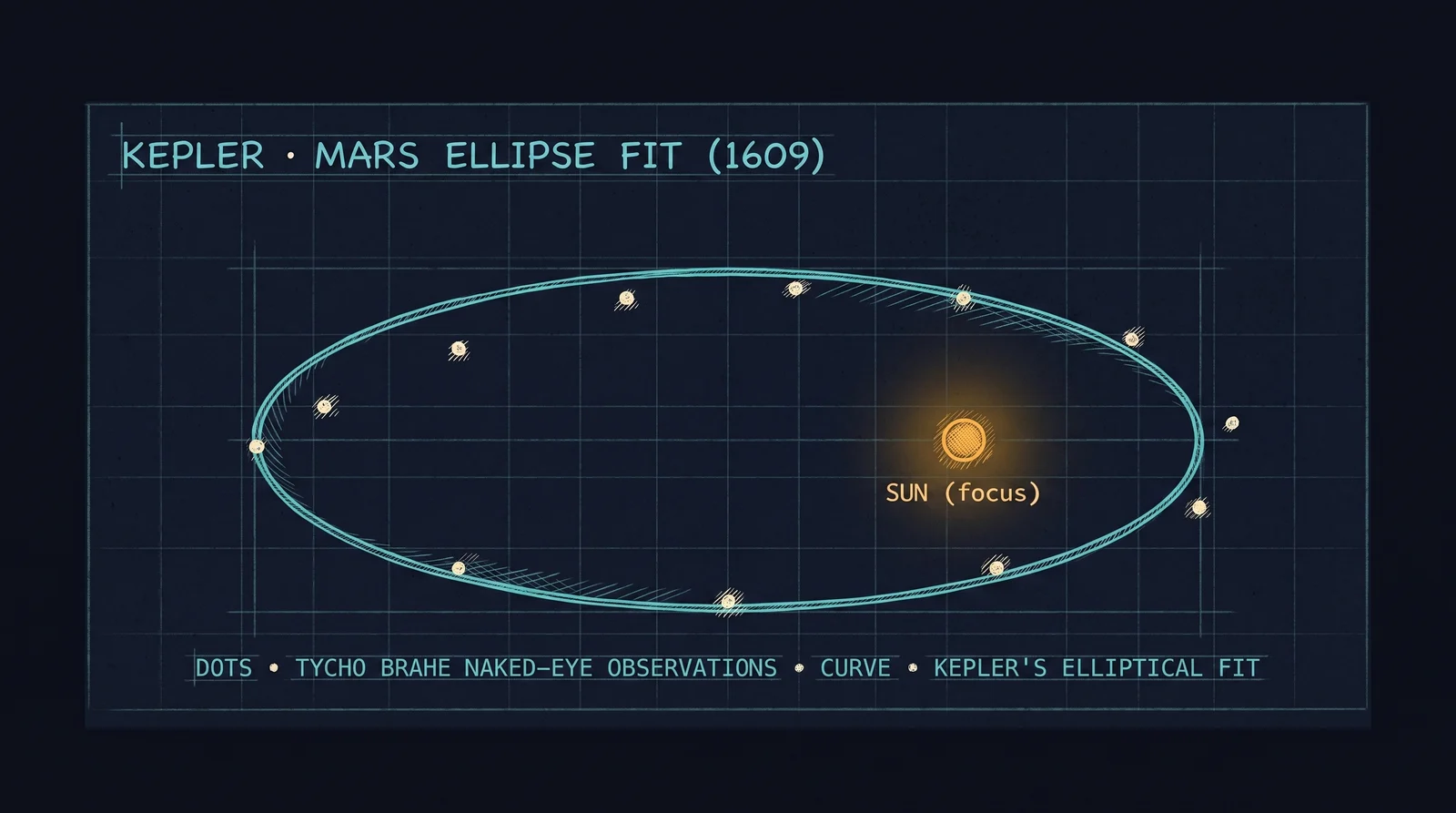
Tycho Brahe spent ~20 years at the Uraniborg observatory on Hven measuring Mars's position with quadrants made of brass and oak — better-than-arcminute precision, all with naked eyes. He died in 1601 having published little of his planetary results.
Kepler inherited the Mars notebooks. He spent another decade trying to fit them to circles and failed. The break came when he tried an ellipse — Mars matched immediately. Out of that came three laws: orbits are ellipses with the Sun at one focus; equal areas swept in equal time; period squared equals semi-major axis cubed.
Without those three laws, no spacecraft trajectory in this app would compute. Every porkchop cell, every transfer arc, every planet on /explore is a Keplerian solution.
Astronomia Nova (1609) published Laws 1 + 2 — the ellipse + equal-areas rules, derived from the Mars opposition data. Harmonices Mundi (1619) published Law 3 — period² ∝ semi-major axis³.
Kepler had no theoretical justification — the laws were empirical patterns extracted from data. Newton would supply the why 70 years later (gravity goes as 1/r²; bound orbits are conic sections; Law 3 falls out of energy conservation).
Brahe's contribution wasn't just data: he was a meticulous instrumentalist who pushed naked-eye measurement to its physical limit. Telescope-grade precision arrived only after Galileo's 1609 telescope — too late to overlap with Brahe's career.
Modern reanalysis: Kepler's Mars residuals are sub-arcminute. He nailed an ellipse with eccentricity 0.0934 from data that had irreducible measurement uncertainty of ~1 arcminute. The fit was real.
SEE IN THE APP
- /explore Every elliptical orbit you see is a direct consequence of Kepler's laws