NASA · USA · 2006–now

New Horizons
It took nine and a half years and the fastest launch in history to reach Pluto — and the dead ball of ice everyone expected turned out to be a young, active world.
Robotic campaign ACTIVE
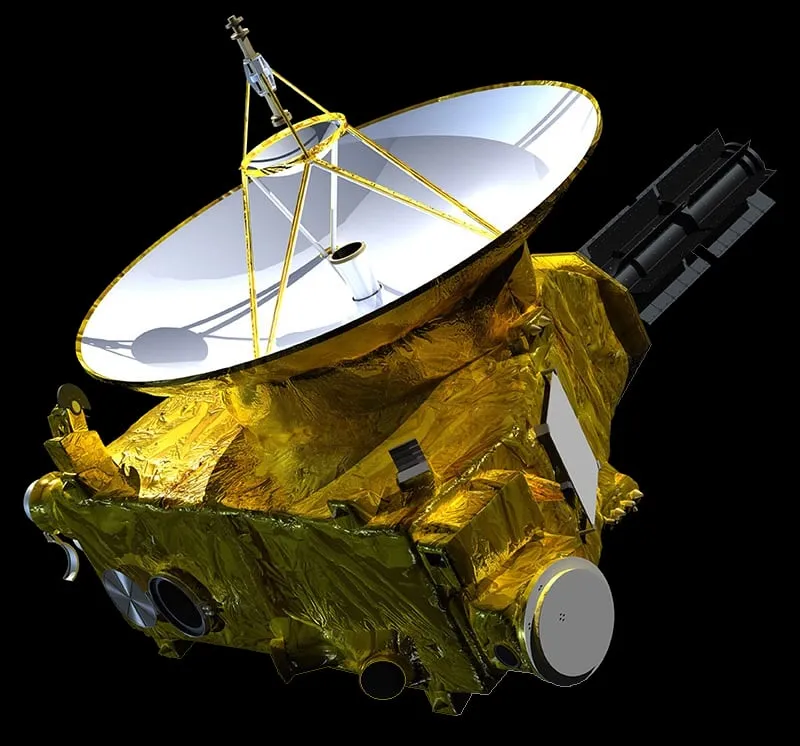
The land
By the turn of the millennium, every planet in the solar system had been visited by a spacecraft except one. Pluto — small, cold, and nearly five billion kilometres out — remained a blur even in the best telescopes, the last unexplored world of the nine planets as they were then counted. It was also receding: its thin atmosphere was expected to freeze out and collapse as it moved away from the Sun, and its orbit would soon carry it into decades of shadow. If anyone was going to see Pluto with air still on it, they had to go soon.
New Horizons was the mission built to beat that clock, and it was designed around speed and thrift. Small, compact, and comparatively cheap, it was launched in 2006 on the most powerful rocket available, given a gravity boost by Jupiter, and sent coasting across the solar system faster than anything before it — a nine-and-a-half-year sprint to a single, unrepeatable flyby.
Goals
The goal was the first close look at Pluto and its large moon Charon: to map them, measure Pluto's thin atmosphere before it could freeze out, and turn the last unexplored planet as it was then counted from a smudge into a place. Because the spacecraft would fly past at enormous speed and could not stop, everything had to work in a few hours, executed by a machine too far away to be helped in real time — a command took hours to reach it.
A second goal was written in once the first was met: if the spacecraft survived Pluto, it would fly on into the Kuiper Belt — the vast ring of icy bodies beyond Neptune — and, fuel permitting, visit one of them, reaching a class of object no mission had ever seen.
Outcome
On 14 July 2015, after nine and a half years, New Horizons swept past Pluto — and overturned the expectation of a dead world. Scientists had braced for a cratered, geologically frozen ball; instead they found towering mountains of water ice, a vast, smooth plain of frozen nitrogen shaped like a heart and churning with slow convection, hazes layered in the thin atmosphere, and signs of geological activity on a world so small and cold it should long ago have gone still. Pluto was young-looking, complex, and alive with process.
Then it kept going. Three and a half years later, on 1 January 2019, New Horizons flew past a tiny, two-lobed body more than a billion and a half kilometres beyond Pluto — later named Arrokoth — the most distant object ever explored up close. It proved to be a pristine relic of the solar system's birth, two spheres that had drifted gently together and stuck, frozen since the beginning. The spacecraft is still flying, still returning data from the outer edge of the planetary system.
The story
The story of New Horizons is a mission that had exactly one chance and took it. There was no orbit, no second pass, no slowing down — nine and a half years of travel converged on a few hours at Pluto, and everything had to work at a distance where the spacecraft was, in effect, on its own. That it executed the flyby flawlessly, at nearly fifty thousand kilometres an hour, is a quiet triumph of doing something once and getting it right.
Its lasting surprise was how wrong the expectation had been. The assumption that a small, ancient, sun-starved world must be geologically dead turned out to be exactly backwards: Pluto is one of the most active surfaces in the solar system, its nitrogen glaciers flowing and its terrain young. New Horizons is a standing reminder that the outer solar system keeps refusing to be the frozen wasteland it was assumed to be — first Enceladus, then Europa, and then a dwarf planet no one thought worth expecting anything from.
And it completed something. With Pluto, a spacecraft had now visited every planet of the old count, closing a reconnaissance of the solar system that began with the Mariners and Pioneers half a century earlier. Then it pushed past the finish line into the Kuiper Belt, reaching the untouched building blocks of the planets themselves — the mission that ended one era of exploration and opened the next.
What it gave back
New Horizons' first legacy is Pluto itself — transformed in a single afternoon from the last unexplored planet of the nine then recognised into a mapped, geologically active world, and the definitive answer to a century of speculation about the ninth point of light.
Its second is Arrokoth and the Kuiper Belt: the first close look at a pristine relic of the solar system's formation, a body untouched since the beginning, and the extension of exploration into the vast icy region beyond Neptune that had never been visited.
Its third is a completed reconnaissance. New Horizons marked the point at which every planet of the old count had been visited by a spacecraft — the closing of a fifty-year first survey of the solar system — while pointing the way onward to the countless small worlds still unseen.
What we can learn
The lesson of New Horizons is that some chances come once, and readiness is everything. There was no do-over at Pluto: a single flyby, executed by a machine too far away to help, after nearly a decade of travel. Missions built around one irreversible moment succeed or fail on the discipline of preparing for it — and New Horizons is proof that a small, focused, well-drilled effort can nail the one shot it gets.
The deeper lesson is to distrust the assumption that distant and old means dead. Everything about Pluto was expected to be frozen and finished; almost nothing was. Again and again the outer solar system has punished the intuition that cold, small, and far from the Sun add up to lifeless — a reminder that the surest way to be surprised is to decide in advance that a place has nothing to show you.
Missions
- 2015
 the fastest spacecraft ever launched, sent across the solar system to make the first close study of Pluto — and then of a world beyond it
 - 2015 Pluto, up close on 14 July 2015 it flew past Pluto, revealing a young, active world of nitrogen glaciers and water-ice mountains where scientists had expected a dead ball of rock
- 2019 Arrokoth on New Year's Day 2019 it flew past Arrokoth, a tiny two-lobed body a billion and a half kilometres beyond Pluto — the most distant object ever explored up close