JAXA · Japan · 2003–now
Hayabusa
Japan's asteroid sample-return campaign — a crippled probe that limped home with the first grains ever taken from an asteroid, and a sequel that did it flawlessly.
Robotic campaign ACTIVE
The land
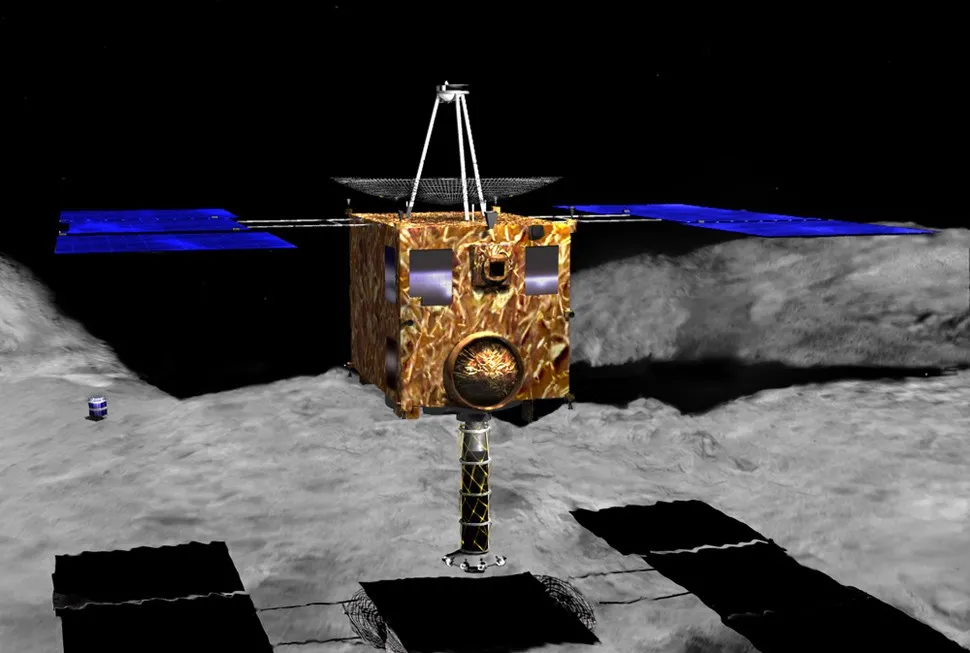
Bringing a piece of another world back to Earth is one of the hardest things a robotic mission can do. You must fly to a target millions of kilometres away, match its orbit, descend to a surface whose gravity is so weak that landing is really a controlled touch, grab material without anchoring, and then fly all the way home and survive reentry. The Moon aside, only a handful of missions in history have returned samples from anywhere — and the first to do it from an asteroid was not American or Russian, but Japanese.
Hayabusa — "Peregrine Falcon" — is JAXA's signature deep-space achievement, and it is as much a story of stubbornness as of engineering. The first mission was a technology demonstrator that suffered almost every failure it could and still came home. The second was a masterclass that executed a far more ambitious plan almost perfectly. Together they made Japan the world's leader in asteroid sample return, and made the little falcon probes into a national saga of persistence.
Goals
The scientific goal is to read the early solar system. Asteroids are leftover building material from the planets' formation, largely unchanged for 4.5 billion years; a pristine sample of one, analyzed in laboratories on Earth rather than by instruments in space, is a direct window into what the solar system was made of before the planets assembled — and, for carbon-rich asteroids like Ryugu, into the organic molecules and water that may have seeded life on Earth.
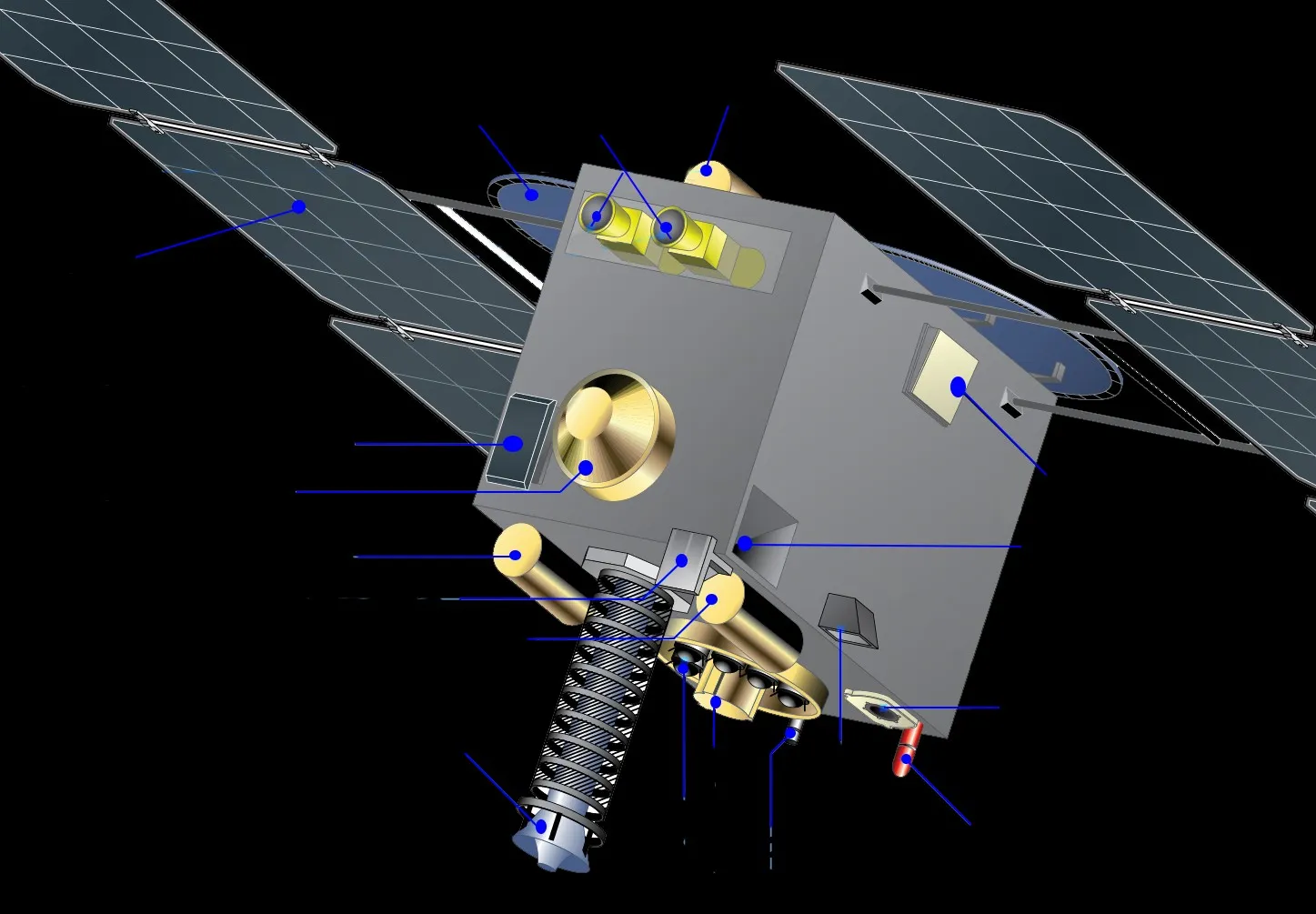
The engineering goal was to prove a whole chain of hard technologies: ion-engine propulsion for the years-long cruise, autonomous navigation down to a tiny, irregular body, a sampling mechanism that works in near-zero gravity, and a reentry capsule to survive the fireball home. The first mission's job was to demonstrate the chain even roughly; the second's was to do it well enough to bring back a substantial, uncontaminated sample.
Outcome
The first Hayabusa, launched in 2003, reached the asteroid Itokawa in 2005 and then nearly died. Two of its three reaction wheels failed, a fuel leak crippled it, its sampling mechanism malfunctioned, contact with Earth was lost for weeks, and three of its four ion engines broke — yet the team coaxed the wounded probe home, and in 2010 its capsule parachuted into the Australian outback carrying roughly 1,500 microscopic grains: the first sample ever returned from an asteroid. It should not have worked, and it did.
Hayabusa2, having learned everything from its predecessor's ordeal, was the opposite experience: a nearly flawless mission. Launched in 2014, it reached the carbon-rich asteroid Ryugu in 2018, deployed hopping rovers onto the surface, fired a copper projectile to blast an artificial crater and collect shielded subsurface material, and returned its capsule to Earth in 2020 with more than five grams of pristine asteroid — a sample already rewriting the chemistry of the early solar system. The probe itself flew on toward another asteroid, its mission extended into the 2030s.
The story
The arc from Hayabusa to Hayabusa2 is the clearest example in this atlas of a program that turned a near-disaster into mastery. The first mission's value was not a clean success — it barely limped home — but everything its team learned surviving its cascade of failures. Reaction wheels, fuel systems, autonomous approach, the reentry capsule: each near-fatal problem became a lesson engineered out of the sequel. Hayabusa2's perfection was built entirely on Hayabusa's suffering.
It is also a distinctly Japanese kind of space program — modest in budget next to NASA's flagships, narrow in focus, and extraordinarily persistent. JAXA did not attempt to do everything; it picked one very hard thing, asteroid sample return, and became the best in the world at it. The result is a specialty that even NASA leans on: samples of Ryugu were shared with American labs, and NASA's own asteroid-return mission, OSIRIS-REx, shared samples with, and drew on the experience of, the Hayabusa team.
And it made robots into protagonists. The first Hayabusa's limp home was followed by millions in Japan as a genuine drama — a machine anthropomorphized into a falcon that would not give up, its final act filmed as it burned up in the atmosphere having released the capsule it had fought seven years to deliver. Few uncrewed missions have carried that kind of public feeling; Hayabusa earned it by refusing to fail.
What it gave back
Hayabusa's first legacy is scientific: pristine asteroid samples in Earth's laboratories, from both a stony asteroid (Itokawa) and a carbon-rich one (Ryugu), directly informing how the solar system formed and how water and organics may have reached the early Earth. These are among the most valuable few grams of material humanity possesses.
Its second legacy is a proven playbook for sample return that the rest of the world now follows. The technologies and hard lessons of the Hayabusa missions fed directly into NASA's OSIRIS-REx and the broader wave of small-body missions — making JAXA's little falcons the pathfinders for an entire class of exploration.
And it is a demonstration that a focused, comparatively modest program can lead the world in a specific, difficult domain. Hayabusa is proof that you do not need the largest budget to hold a genuine first — only the discipline to pick one hard problem and refuse to let it beat you.
What we can learn
The lesson of Hayabusa is that a mission that barely survives can be worth more than one that goes smoothly, if the survival is instrumented and learned from. The first probe's cascade of failures was, in the end, the most valuable thing about it — every near-fatal problem became knowledge that made the flawless sequel possible. Failure, fully understood, is a form of progress.
The deeper lesson is the power of focus. JAXA could not out-spend NASA on everything, so it chose one extraordinarily hard thing and became the best in the world at it. In a field where the temptation is always to attempt more, Hayabusa is a case for doing less, deeper — and holding a first that larger programs then have to come to you to learn.
Missions
- 2005 reaches asteroid Itokawa, touches down twice, and — despite crippling failures — brings home the first sample ever taken from an asteroid
- 2018 reaches Ryugu, fires a projectile to make an artificial crater, collects subsurface material, and returns it to Earth in 2020 — a flawless run
Hardware
- Hayabusa sample-return probe
- Hayabusa 2 sample-return probe