Roscosmos · USSR · 1957–1958

Sputnik
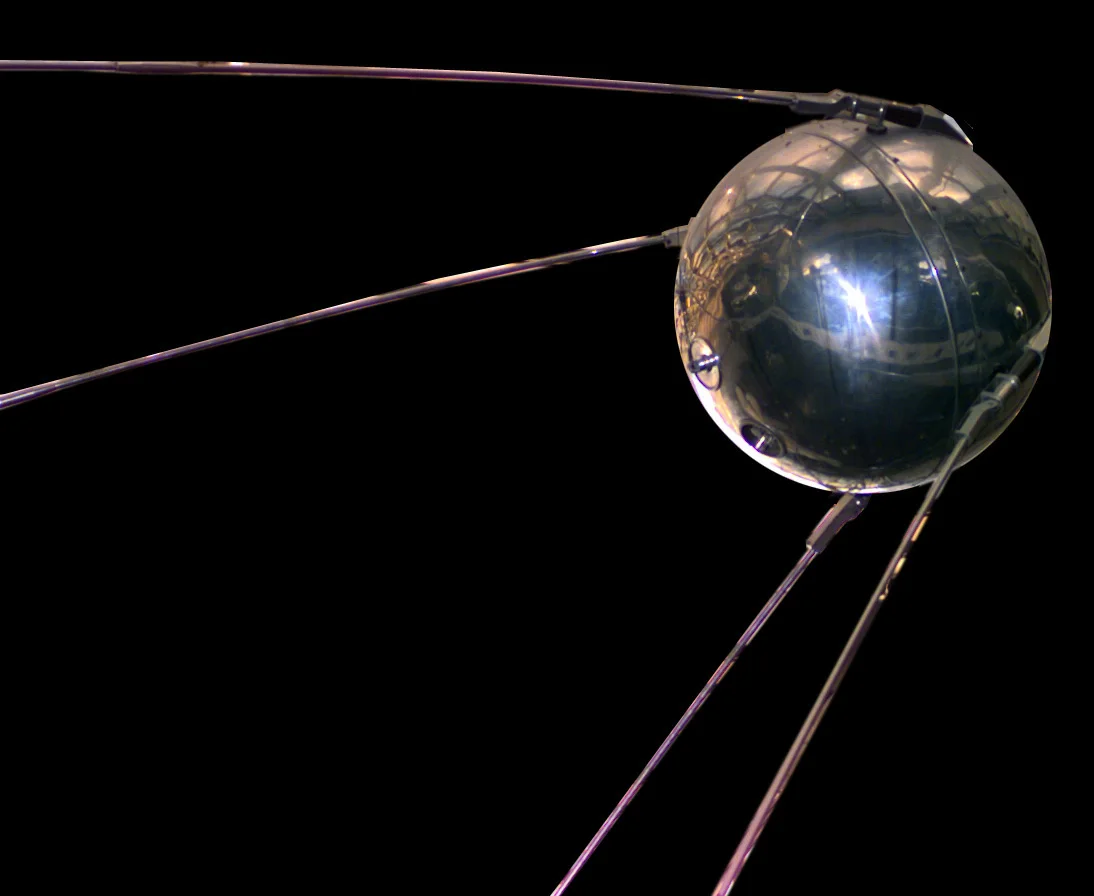
On 4 October 1957 a polished metal sphere the size of a beach ball began to beep from orbit — and the space age, and the space race, began in the same instant.
Robotic campaign COMPLETED
The land
By the mid-1950s the two Cold War superpowers were building rockets for the same reason: to carry hydrogen bombs across the world. The Soviet Union's chief designer, Sergei Korolev, was building one of the first — the R-7, an intercontinental ballistic missile powerful enough to loft a heavy warhead. It was also, not coincidentally, powerful enough to throw a small object past the edge of the atmosphere and into orbit. Both nations had announced satellites for the International Geophysical Year of 1957–58. The question was only who would be first.
The Soviets had planned an elaborate scientific satellite — a heavy, instrument-packed laboratory called Object D. It was running late. Fearing the Americans would beat him, Korolev set the complicated craft aside and proposed something almost absurdly simple in its place: a shiny metal ball with a radio transmitter, light enough to launch immediately. It was called PS-1 — Prosteyshiy Sputnik, "simplest satellite." Its whole job was to get to orbit first, and to be heard.
Goals
The goal was to be first — and to be unmistakable about it. A satellite in orbit was proof, visible to the whole world, that Soviet rockets could reach any point on Earth; the same booster that placed a sphere over Washington could place a warhead there. Sputnik was a scientific object, but its deeper purpose was a demonstration of power and a claim to the future, broadcast on frequencies any amateur radio operator on the planet could tune in and hear for themselves.
The design followed from the goal. Strip away everything that could delay the launch: no cameras, no experiments beyond a temperature and pressure sensor wired to the transmitter, just a battery, a radio, and a mirror-bright shell chosen so the spent rocket stage would be visible from the ground. Do the least that would still count as a satellite, and do it before the Americans could do more.
Outcome
On 4 October 1957 an R-7 lifted off from the Kazakh steppe and Sputnik 1 reached orbit. For twenty-two days its two transmitters sent a steady beep — beep — beep across the shortwave bands, a sound broadcast on the evening news and picked up by radio hams around the world, until the batteries died. The sphere itself circled on until early January 1958, when it burned up on re-entry. The whole world had heard the first artificial moon.
The Soviets pressed the advantage immediately. A month later, on 3 November, Sputnik 2 carried Laika — a Moscow street dog — into orbit, the first living creature to leave the planet. The mission proved that a living body could survive launch and weightlessness, but there was no capacity to bring her home, and she died of overheating within hours. The following spring, Sputnik 3 finally flew the heavy geophysical laboratory the program had meant to launch first.
In the United States the reaction was less wonder than shock. That a rival could put a machine over American skies — and had the rocket to do it — triggered what became known as the Sputnik crisis: a wave of alarm that reshaped the country's priorities almost overnight, from schoolroom science to national defence.
The story
The story of Sputnik is that simplicity, aimed precisely, can beat sophistication. The Soviets did not win the first round of the space age with the best satellite; they won it with the fastest one. Korolev's instinct — that being first mattered more than being elaborate, that a beeping sphere would change the world more than a laboratory launched a year later — was exactly right. The elaborate satellite, Object D, would have been better science. The simple one made history.
It is also a story about the power of a signal. Sputnik carried almost no instruments; its payload was essentially the fact of itself, announced in a tone anyone could hear. That was the point. A satellite you can only read about is an abstraction; a beep coming out of your own radio, from a machine passing overhead every ninety-six minutes, is undeniable. The Soviets understood that the first satellite's most important instrument was the one that let the whole planet witness it.
And it is the opening scene of everything that follows. Every program in this atlas — the crewed flights, the Moon landings, the stations, the robots sent to other worlds — descends from the moment a metal ball beeped over the Earth and proved that space was reachable. The race that Sputnik started would run for decades and put twelve people on the Moon. It began with the least complicated machine anyone could get to orbit in a hurry.
What it gave back
Sputnik's first legacy is the starting gun. It opened the space age and set off the space race, and every subsequent milestone — Gagarin, Apollo, the stations, the interplanetary robots — traces back to the alarm and ambition it unleashed. The single most consequential object of the early space era was also one of the simplest.
Its second legacy is American: the Sputnik crisis drove the United States to found NASA in 1958, to pour money into science and mathematics education through the National Defense Education Act, and to treat spaceflight as a matter of national survival. A Soviet beep did as much to build the American space program as any American decision.
And its third is Laika. The first living creature in orbit was also the first to die there, sent up with no way back in the rush to stay ahead. She proved that life could survive spaceflight and opened the road to human orbit — and she remains the enduring reminder of the cost, and the haste, of those first steps.
What we can learn
The lesson of Sputnik is that firsts are won by whoever is ready, not by whoever is best. The Soviets had the better satellite waiting on the ground; they launched the lesser one because it could go now, and being first turned out to matter more than any instrument Object D could have carried. When the prize is a first, readiness beats perfection.
The deeper lesson is that the most powerful thing a machine can do is be witnessed. Sputnik changed the world not through what it measured but through what it demonstrated — visibly, audibly, to everyone at once. Some achievements matter because of the data they return; this one mattered because the whole planet could hear that it was there.
Missions
- 1957 4 October 1957 — the first artificial satellite, a 58-centimetre polished sphere with four whip antennas that circled the Earth every 96 minutes and beeped on shortwave for three weeks
- 1957 Sputnik 2 3 November 1957 — carried Laika, a Moscow street dog and the first living creature to orbit the Earth; the capsule had no way to bring her home
- 1958 Sputnik 3 15 May 1958 — a 1.3-tonne geophysical laboratory, the elaborate science satellite the program had originally meant to launch first