Podcast Scraper Architecture¶
Strategic Overview: This document provides high-level architectural decisions, design principles, and system structure. For detailed implementation guides, see the Development Guide and other specialized documents linked below.
Navigation¶
This architecture document is the central hub for understanding the system. For detailed information, see:
Core Documentation¶
- ADR Index — The immutable record of architectural laws and decisions
- Architecture — Ways to run and deploy — CLI vs service vs Docker; one pipeline, one Config
- Non-Functional Requirements — Performance, security, reliability, observability, maintainability, scalability
- Development Guide — Detailed implementation instructions, dependency management, code patterns, and development workflows
- Pipeline and Workflow Guide — Pipeline flow, module roles, behavioral quirks, run tracking
- Testing Strategy — Testing philosophy, test pyramid, and quality standards
- Testing Guide — Quick reference and test execution commands
- Unit Testing Guide — Unit test mocking patterns
- Integration Testing Guide — Integration test guidelines
- E2E Testing Guide — E2E server, real ML models
- Critical Path Testing Guide — What to test, prioritization
- Server Guide — FastAPI server, REST API, viewer, development workflow
- Viewer Frontend Architecture — Vue SPA internals: component tree, Pinia stores, API layer, async correctness
- CI/CD — Continuous integration and deployment pipeline
API Documentation¶
- API Reference — Complete API documentation
- Configuration — Configuration options and examples
- CLI Reference — Command-line interface documentation
Feature Documentation¶
- Provider Implementation Guide — Complete guide for implementing new providers (includes OpenAI example, testing, E2E server mocking)
- ML Provider Reference — ML implementation details
- Configuration API — Configuration API reference (includes environment variables)
Specifications¶
- PRDs — Product Requirements Documents
- RFCs — Request for Comments (design decisions)
- Unified Corpus Ontology (v2) —
single source of truth for KG v2.0+ and GI v3.0+
(RFC-097, 2026-06-20); two-tier edge contract,
Person/Organization/Podcastfirst-class,ABOUT/MENTIONS_PERSON/MENTIONS_ORG,insight_type+position_hint - GIL Ontology — Grounded
Insight Layer node/edge types and grounding contract
(superseded by
corpus/ontology.mdfor v3.0+; retained for archaeology) - GIL Schema — Machine-
readable JSON schema for
gi.jsonvalidation - GIL / KG / CIL cross-layer —
bridge.json, CIL HTTP queries, search lift, offset verification (RFC-072)
Goals and Scope¶
- Provide a resilient pipeline that collects podcast episode transcripts from RSS feeds and fills gaps via Whisper transcription.
- Offer both CLI and Python APIs with a single
configuration surface (
Config) and deterministic filesystem layout. - Keep the public surface area small (
Config,load_config_file,run_pipeline,service.run,service.run_from_config_file,cli.main) while exposing well-factored submodules for advanced use. - Provide a service API (
service.py) optimized for non-interactive use (daemons, process managers) with structured error handling and exit codes. - Support a multi-provider architecture with
local ML (
MLProvider), hybrid MAP-REDUCE (HybridMLProvider), and 7 LLM providers (OpenAI, Gemini, Anthropic, Mistral, DeepSeek, Grok, Ollama) enabling choice across cost, quality, privacy, and latency dimensions. - Enable structured knowledge extraction via the Grounded Insight Layer (GIL) — extracting insights and verbatim quotes with evidence grounding from podcast transcripts (PRD-017).
- Enable Knowledge Graph (KG) extraction from transcripts and summaries, producing structured topic graphs per episode.
- Provide semantic corpus search (PRD-021) via LanceDB vector indexing over transcript chunks, enabling natural-language queries and episode similarity across multi-feed corpora.
- Expose a read-oriented HTTP API and viewer (RFC-062) with corpus library browsing (RFC-067), corpus digest (RFC-068), graph exploration (RFC-069), and semantic search — served as a FastAPI + Vue 3 SPA.
- Support canonical cross-layer identity (CIL,
RFC-072): per-episode
bridge.jsonjoins GIL and KG under sharedperson:/topic:/org:ids; read-only CIL HTTP APIs and optional transcript hit lift in semantic search depend on aligned Quote and indexed transcript chunk char offsets. Overview: GIL / KG / CIL cross-layer guide.
Ways to run and deploy¶
The system has one pipeline (workflow.run_pipeline) and one configuration model (Config). Both entry points produce a Config and call the same pipeline; only how config is supplied and how results are surfaced differs.
| Mode | Use case | Config source | Entry / deployment |
|---|---|---|---|
| CLI | Interactive runs, ad-hoc flags, progress bars | CLI args + optional --config file |
podcast-scraper <rss_url>, repeatable --rss, python -m podcast_scraper.cli. Multi-feed: --output-dir required when ≥2 feeds (CLI.md). Subcommands: doctor, cache, corpus-status (#506). |
| Service | Daemons, automation, process managers | Config file only (no CLI args) | python -m podcast_scraper.service --config config.yaml. YAML feeds / rss_urls list runs one pipeline per feed when len ≥ 2. Returns ServiceResult; exit code 0/1. For supervisor, systemd, etc. |
| Docker | Service-oriented deployment | Config file (default /app/config.yaml or PODCAST_SCRAPER_CONFIG) |
Container runs service mode: no CLI arguments, config from file and env. See Docker Service Guide. |
| Server (viewer) | GI/KG graph, dashboard, semantic search, explore, Corpus Library, index stats / rebuild | --output-dir (corpus path) |
podcast serve --output-dir <path>. FastAPI + Vue SPA; OpenAPI at /docs. Needs pip install -e ".[dev]". See Server Guide and API index — HTTP. |
Programmatic use: Import config.load_config_file, Config, and either workflow.run_pipeline (returns count + summary) or service.run / service.run_from_config_file (returns ServiceResult). See API Reference and Service API.
Server / viewer: src/podcast_scraper/server/ is the canonical read-oriented HTTP layer exposing REST endpoints for the Vue SPA. routes/platform/* remains stub-only (not registered in create_app) until ADR-064 platform routes land (#50, #347). OpenAPI: /docs, /openapi.json. See Server Guide for the API contract and Viewer Frontend Architecture for the SPA internals.
GIL, KG, and canonical cross-layer (CIL)¶
GIL (gi.json) and KG (*.kg.json) stay separate artifacts (ADR-052). RFC-072 adds bridge.json per episode: a compact list of canonical identities (person:…, topic:…, org:…) with display_name and provenance so HTTP APIs and the viewer can join layers without merging the full ontologies.
Consumption today:
- Viewer — Loads GI/KG (and bridge where present) via
GET /api/artifacts; graph merge and catalog rows may use bridge paths from metadata (Server Guide, RFC-062). - CIL query API — Filesystem scans for
*.bridge.jsonwith siblinggi.json/kg.json; patterns for person/topic arcs and timelines (RFC-072 § query patterns). - Semantic search — Transcript hits can expose an optional
liftedobject (insight, speaker, topic, quote timestamps) when chunk char ranges overlap a Quote and edges/bridge.jsonallow resolution (Semantic Search Guide).
Shared implementation seams: src/podcast_scraper/builders/bridge_artifact_paths.py is the single place for bridge / GI / KG sibling path rules (metadata → bridge.json, bridge.json → gi.json/kg.json, gi.json → bridge.json). src/podcast_scraper/gi/edge_normalization.py normalises GIL edge type strings for graph walks (CIL queries and search lift). build_bridge payload assembly stays in builders/bridge_builder.py.
Operational gate: Before relying on lift in production-shaped corpora, run Quote vs chunk offset verification (verify-gil-chunk-offsets or make verify-gil-offsets-strict) on an indexed run. Details: Semantic Search Guide — lift and verification, GIL / KG / CIL cross-layer guide.
Re-pipeline stance: Re-running extraction, the bridge builder, or RFC-075 clustering replaces on-disk artifacts under the corpus root. Canonical ids and tc: cluster parents are not frozen at first ingest. HTTP APIs and the viewer read current files for the configured path. See RFC-072 — Operational note and GIL / KG / CIL — When the corpus is re-built.
Full spec: RFC-072.
Corpus Topic Clustering Layer (RFC-075)¶
Purpose: Group semantically similar KG topic nodes across episodes when LLMs assign different topic:{slug} ids for the same real-world subject. This is a corpus-level, optional step that sits beside per-episode KG extraction and beside CIL: it reads KG topic labels and embeddings produced for semantic search (RFC-061), writes a small filesystem artifact topic_clusters.json under <corpus>/search/, and can feed auto-generated topic_id_aliases for CIL (RFC-072). The GI/KG viewer may render clusters as Cytoscape compound parent nodes without rewriting raw *.kg.json.
Boundaries:
- In scope: Build-time or CLI-triggered clustering; optional operator-authored YAML for
topic-clusters --validate-config(no committed canonical file); HTTP surface to serve the JSON artifact; viewer overlay only. - Out of scope: Replacing KG extraction, replacing the LanceDB search index, or requiring a database. No query-time external embedding APIs.
Design: RFC-075 (Draft) — current writers emit schema_version: "2" with distinct graph_compound_parent_id (viewer) vs cil_alias_target_topic_id (CIL).
Insight Clustering Layer (#599)¶
Purpose: Group semantically similar GI insights across episodes. While topic clustering groups KG topic labels, insight clustering groups the actual claims/findings extracted by the GI pipeline. Each cluster aggregates supporting quotes from multiple episodes, enabling cross-episode evidence queries.
Boundaries:
- In scope: CLI-triggered clustering via
insight-clusterscommand;--expand-clustersflag ongi explorefor cross-episode evidence; insight_clusters.json artifact. - Out of scope: Speaker profiles, consensus detection, temporal tracking (parked — need diarization data).
Design: Same average-linkage algorithm as topic clustering (RFC-075). Reads insight texts from *.gi.json artifacts, embeds with sentence-transformers, clusters at configurable threshold (default 0.75). The cluster context expansion layer (insight_cluster_context.py) adds cross-episode quotes to explore results without modifying the core explore pipeline.
Multi-quote extraction (#600): All 8 providers extract multiple verbatim quotes per insight (uncapped, typically 3-5 on real podcasts). Parser handles both new {"quotes": [...]} format and backward-compatible {"quote_text": "..."}. ML provider uses answer_candidates(top_k=3). Quote deduplication by text prevents LLM repetition.
Providers: Nine providers (1 local ML + 1 hybrid ML + 7 LLM) supply transcription, speaker detection, and summarization; capability matrix and selection are in Pipeline and Workflow Guide. Adding or extending providers: Provider Implementation Guide.
Enrichment Layer (RFC-088)¶
Purpose: A fourth artifact tier on top of GIL / KG / bridge. Typed, opt-in enrichers run after the core pipeline (as a peer verb, python -m podcast_scraper.cli enrich, or auto-chained after a run), read the frozen core artifacts, and write their own JSON envelopes under enrichments/ — cross-corpus signals (co-occurrence, similarity, velocity, grounding, co-appearance, density, themes) the viewer + consumer app consume for ranking, badges, and discovery. enrichment/ is a modular framework: protocol + registry + a tier-aware executor (retry / circuit / auto-disable / heartbeat / per-enricher + run cost caps) + a provider-type registry that lets operators pick a backend by name in YAML.
Boundaries (ADR-104):
- In scope: enrichers that read
*.gi.json/*.kg.json/*.bridge.jsonand writeenrichments/<id>.json(corpus scope) ormetadata/enrichments/{stem}.<id>.json(episode scope) — ranking / scoring / UI-consumption signals only. - Out of scope: enrichers never modify core artifacts (immutable after the core pipeline writes them). Graph traversal / connectivity that feeds relational queries or LLM grounding is core pipeline, not enrichment (e.g. RFC-097 chunk 9's
RELATED_TOedges). The rubric: traversal → core, ranking → enrichments. See ADR-104.
The enricher set (9 batch + 1 query):
- 7 deterministic (pure Python over KG/GI, no model / no network):
grounding_rate,guest_coappearance,insight_density(episode),insight_sentiment(episode — per-Insight VADER compound + neg/neu/pos, the conversation-timeline colour layer),temporal_velocity,topic_cooccurrence_corpus,topic_theme_clusters. - 1 embedding:
topic_similarity(per-Topic Top-K cosine neighbours; validated recall@10 99%, top_k tuned to 7, #1105). - 1 ML —
topic_consensus(promoted): the ADR-108 reimagining of the retired 0%-precisionnli_contradiction— cross-Person corroboration via a composite of embedding cosine + low NLI contradiction (no LLM); precision 0.91 on prod-v2, so the accuracy gate admits it. Its siblingstance_disagreement/stance_timelinewas retired: the eval showed the stance signal is genuinely absent on factual insights, and per-person / per-topic stance-over-time is better served as a read-time CIL query (conversation-arc/position-arc) coloured byinsight_sentiment— not a gated ML enricher. See ADR-108. - 1 query enricher:
query_topic_relatednessdecorates/api/searchhits withtopic_similarityneighbours inline (per-request, not a batch envelope).
Accuracy gate (data-driven admission): an enricher may declare an accuracy_gate (a precision floor) on its manifest. enrichment/eval/admission.py reads the latest data/eval/enrichment/<id>/gate_metrics.json and, through profile_sets._admit, filters the registry → profiles → UI: a gated enricher stays dark until an eval records passing precision, and auto-promotes with no code edit once one does. Profiles list candidates; the gate decides membership. This is the firewall that keeps the 0%-precision disagreement detectors from surfacing fabricated signals. The live cross-speaker surface is instead perspectives (#1146) — a CIL query over the GI (not an enricher, so it sidesteps the gate).
Surfacing: envelopes reach the operator viewer (web/gi-kg-viewer/) via /api/corpus/enrichments/* (topic/person node-rail signals, episode density bars, the Dashboard trending + multi-perspective cards, the graph enrichment-edges panel) and the consumer app (web/learning-player/) via /api/app/corpus/enrichment (entity-card EntitySignals: grounding, co-appears, momentum, similar, discussed-alongside) + /api/app/episodes/{slug}/enrichment (density). Operator control (run / status / health / config / re-enable) is /api/enrichment/*. Full reference: Enrichment Layer Guide + Enrichment Layer API; spec in RFC-088.
Architectural Decisions (ADRs)¶
The following architectural principles govern this system. For the full history and rationale, see the ADR Index.
Core Patterns¶
- Concurrency: IO-bound threading for downloads, sequential CPU/GPU tasks for ML (ADR-001). MPS exclusive mode (ADR-046) serializes GPU work on Apple Silicon to prevent memory contention when both Whisper and summarization use MPS (enabled by default).
- Providers: Protocol-based discovery (ADR-020) using unified provider classes (ADR-024), library-based naming (ADR-025), and per-capability provider selection (ADR-026).
- Lazy Loading: Heavy ML dependencies are loaded only when needed (ADR-005).
Data & Filesystem¶
- Storage: Hash-based deterministic directory layout (ADR-003) with flat archives (ADR-004).
- Identity: Universal GUID-based episode identification (ADR-007).
- Metadata: Unified JSON schema compatible with SQL and NoSQL (ADR-008).
ML & AI Processing¶
- Summarization: Hybrid MAP-REDUCE strategy (ADR-010, ADR-043) favoring local models (ADR-009).
- Audio: Mandatory preprocessing (ADR-036) with content-hash caching (ADR-037) using FFmpeg (ADR-038) and Opus (ADR-039).
- Governance: Explicit benchmarking gates (
ADR-042(moved to the private eval repo as ADR-011)) and golden dataset versioning (ADR-040(moved to the private eval repo as ADR-009)).
Development & CI¶
- Workflow: Git worktree-based isolation (ADR-032) with independent environments (ADR-034).
- Quality: Three-tier test pyramid (ADR-019) with automated health metrics (ADR-023). The viewer applies its own three-tier variant with production-shaped fixtures (ADR-095, RFC-086) so cross-surface graph handoffs land in a contract test before any fix merges.
- Viewer graph handoff orchestrator (FSM): a single 8-state machine owns every cross-surface graph handoff — Library, Digest, Search, Dashboard, Episode panel, canvas, mini-map (ADR-094, RFC-085). Generation tokens supersede stale work, a 5s wall-clock detector surfaces stuck handoffs via a visible error strip, and a
layoutstop-driven invariant repairs filteredArtifact ↔ Cytoscape divergence in production. See VIEWER_GRAPH_SPEC and VIEWER_FRONTEND_ARCHITECTURE for the orchestrator wiring. - Always-on hosting (VPS): ADR-079 through ADR-083 record OpenTofu, encrypted in-repo state, drill workspace and ACL ownership, GitHub Actions app GitOps after stack-test, and Tailscale-only ingress; ADR-089–ADR-091 lock prod failover decisions (RFC-083 Completed — orchestrator + 8 drill-* workflows shipped); RFC-082 and PROD_RUNBOOK keep the full design and procedures.
- Compose, CI gates, CIL, autoresearch v2, macOS ML safety: ADR-084 (full-stack Compose), ADR-085 (ephemeral stack-test on
main), ADR-086 (CIL +bridge.json),ADR-087autoresearch Track A v2 (moved to the private eval repo as ADR-006), ADR-088 (local ML process safety); normative specs in RFC-079, RFC-078, RFC-072,RFC-073(moved to the private eval repo as RFC-003), RFC-074. - Always-on hosting narrative: Hosting and infrastructure (diagrams and how the planes fit together; complements ADR-079–083 and RFC-082).
- Cross-surface stack contract (audit table, steady vs recovery): STACK_CONTRACT.md (ADR-093).
- Process Safety (RFC-074): ML model loading (spaCy, Transformers, Whisper) triggers heavy APFS filesystem I/O that can cause macOS kernel lock contention. Mitigations: no ML imports at Makefile parse time, filesystem-only cache checks, pre-commit hook timeout (120s),
cleanup-processesprerequisite onci/ci-fast, offline-mode enforcement (HF_HUB_OFFLINE,TRANSFORMERS_OFFLINE), and agent rules preventing overlappingmake ciruns. Diagnostic targets:make check-zombie(detects unkillable UE-state processes) andmake check-spotlight(verifies Spotlight indexing status).
Reproducibility & Operational Hardening (Issue #379)¶
- Determinism: Seed-based reproducibility for
torch,numpy, andtransformersensures consistent outputs across runs. Seeds are configurable via environment variables or config files. - Run Tracking: Comprehensive run manifests capture system state (Python version, OS, GPU info, model versions, git commit SHA, config hash) for complete reproducibility. Per-episode stage timings track processing duration for performance analysis.
- Failure Handling: Configurable
--fail-fastand--max-failuresflags allow operators to control pipeline behavior on episode failures. Episode-level failures are tracked in metrics without affecting exit codes. - Retry Policies: Three-layer retry for transient errors: (1) urllib3 retry adapters on every HTTP request with configurable counts and exponential backoff (
http_retry_total,rss_retry_total); (2) application-level episode retry that re-runs the entire episode download on transient network errors (episode_retry_max, default 1); (3) model loading retry viaretry_with_exponential_backoff. All retry parameters are configurable viaConfigwith resilient defaults active out of the box. See CONFIGURATION.md -- Download Resilience. - Timeout Enforcement: Configurable timeouts for transcription and summarization stages prevent hung operations.
- Security: Path validation prevents directory traversal attacks. Model allowlist validation restricts HuggingFace model sources. Safetensors format preference improves security and performance.
trust_remote_code=Falseenforced on all model loading. - Structured Logging:
--json-logsflag enables structured JSON logging for log aggregation systems (ELK, Splunk, CloudWatch). - Diagnostics:
podcast_scraper doctorcommand validates environment (Python version, ffmpeg, write permissions, model cache, network connectivity).
Pipeline and Workflow¶
The pipeline processes podcast feeds through a sequence of stages: RSS acquisition, episode selection, transcript download (or Whisper transcription), optional metadata generation, optional summarization, optional GIL/KG extraction, and optional LanceDB vector indexing. Multi-feed corpora run the inner pipeline per feed with a single parent index pass. Append/resume mode skips already-processed episodes.
For the full stage-by-stage walkthrough, pipeline flow diagram, module roles, multi-feed semantics, and behavioral details see the Pipeline and Workflow Guide.
Module map (summary)¶
| Package / module | Responsibility | Detail link |
|---|---|---|
cli.py |
CLI entry, arg parsing, multi-feed outer loop | CLI Reference |
service.py |
Daemon/programmatic entry, ServiceResult |
Service API |
config.py |
Immutable Config model, YAML/JSON loader |
Configuration |
workflow/ |
Orchestration, stages, degradation, corpus ops, run tracking | Pipeline Guide |
rss/ |
RSS parsing (defusedxml), HTTP downloads, feed cache |
RSS Guide |
providers/ |
9 unified providers (ML, Hybrid, 7 LLM); factories, capabilities, prompts | Provider Guide |
providers/tailnet_dgx/ |
Self-hosted DGX inference providers: whisper transcription + pyannote diarization over tailnet | ADR-096, RFC-089 |
providers/resilience/ |
Deployment-agnostic primitives: CircuitBreaker, TimeoutLike, run_with_watchdog, hardened_http_client (TCP keepalive + Connection: close). Used by tailnet_dgx/* today; available to any provider that needs connection-level resilience. |
ADR-105 |
providers/guardrails/ |
Response-shape sanity checks: check_chat_response, check_whisper_response, check_diarization_response — raise GuardrailViolation when a 200 OK response contains semantically-corrupted content (empty, thinking-prose, finish_reason=length, malformed JSON). Wired at every chat-completion call site across cloud + self-hosted providers. |
ADR-105, ADR-100 |
gi/ |
Grounded Insight Layer extraction (PRD-017) | GI Guide |
kg/ |
Knowledge Graph extraction (RFC-055) | KG Guide |
enrichment/ |
Enrichment layer (RFC-088): typed enrichers + registry + tier-aware executor + data-driven accuracy gate; writes enrichments/ envelopes read by both UIs |
Enrichment Guide, ADR-104 |
search/ |
LanceDB vector indexing, semantic search, episode similarity; corpus topic clustering (topic_clusters.json, RFC-075) |
Search Guide, RFC-075 |
server/ |
FastAPI HTTP layer, corpus catalog, digest, index rebuild | Server Guide, Viewer Frontend |
monitor/ |
Live pipeline monitor (RFC-065) | Monitor Guide |
models/ |
Shared dataclasses (RssFeed, Episode, etc.) |
|
utils/ |
Filesystem helpers, progress reporting |
Module Dependencies Diagram¶
graph TB
    subgraph "Public API"
        CLI[cli.py]
        Config[config.py]
        Service[service.py]
        Workflow[workflow/orchestration.py]
    end

    subgraph "Core Processing"
        RSSParser[rss/parser.py]
        EpisodeProc[workflow/episode_processor.py]
        Downloader[rss/downloader.py]
        AudioPreproc[preprocessing/]
    end

    subgraph "Support Modules"
        Filesystem[utils/filesystem.py]
        Models[models/]
        Progress[utils/progress.py]
        Schemas[schemas/summary_schema.py]
    end

    subgraph "Prompt Management"
        PromptStore[prompts/store.py]
        PromptTemplates[prompts/provider/task/v1.j2]
    end

    subgraph "Provider System"
        TranscriptionFactory[transcription/factory.py]
        SpeakerFactory[speaker_detectors/factory.py]
        SummaryFactory[summarization/factory.py]
        Capabilities[providers/capabilities.py]
    end

    subgraph "Local ML Provider"
        MLProvider[providers/ml/ml_provider.py]
        HybridMLProvider[providers/ml/hybrid_ml_provider.py]
        ModelRegistry[providers/ml/model_registry.py]
        Whisper[providers/ml/whisper_utils.py]
        SpeakerDetect[providers/ml/speaker_detection.py]
        Summarizer[providers/ml/summarizer.py]
        NER[providers/ml/ner_extraction.py]
    end

    subgraph "LLM Providers"
        OpenAIProvider[providers/openai/]
        GeminiProvider[providers/gemini/]
        AnthropicProvider[providers/anthropic/]
        MistralProvider[providers/mistral/]
        DeepSeekProvider[providers/deepseek/]
        GrokProvider[providers/grok/]
        OllamaProvider[providers/ollama/]
        TailnetDgxProvider[providers/tailnet_dgx/]
    end

    subgraph "Provider Cross-cutting"
        Resilience[providers/resilience/]
        Guardrails[providers/guardrails/]
    end

    OpenAIProvider --> Guardrails
    GeminiProvider --> Guardrails
    AnthropicProvider --> Guardrails
    DeepSeekProvider --> Guardrails
    OllamaProvider --> Guardrails
    TailnetDgxProvider --> Resilience
    TailnetDgxProvider --> Guardrails

    subgraph "Semantic Search"
        SearchIndexer[search/indexer.py]
        LanceBackend[search/backends/lancedb_backend.py]
        Chunker[search/chunker.py]
        CorpusSearch[search/corpus_search.py]
        CorpusSimilar[search/corpus_similar.py]
        CorpusScope[search/corpus_scope.py]
    end

    subgraph "Corpus Topic Clustering (RFC-075)"
        TopicClusters[search/topic_clusters.py]
    end

    subgraph "Server Layer"
        ServerApp[server/app.py]
        ServerRoutes[server/routes/]
        ServerSchemas[server/schemas.py]
        CorpusCatalog[server/corpus_catalog.py]
        CorpusDigest[server/corpus_digest.py]
        CorpusTopicClusters[server/routes/corpus_topic_clusters.py]
        IndexRebuild[server/index_rebuild.py]
        IndexStaleness[server/index_staleness.py]
    end

    subgraph "Knowledge Extraction"
        GI[gi/pipeline.py]
        GISchema[gi/schema.py]
        GIGrounding[gi/grounding.py]
        KG[kg/pipeline.py]
        KGSchema[kg/schema.py]
        KGExtract[kg/llm_extract.py]
    end

    subgraph "Workflow Stages"
        StageSetup[workflow/stages/setup.py]
        StageScraping[workflow/stages/scraping.py]
        StageProcessing[workflow/stages/processing.py]
        StageTranscription[workflow/stages/transcription.py]
        StageMetadata[workflow/stages/metadata.py]
        StageSummarization[workflow/stages/summarization.py]
    end

    subgraph "Optional Features"
        Metadata[workflow/metadata_generation.py]
        CorpusOps[workflow/corpus_operations.py]
        Degradation[workflow/degradation.py]
        Evaluation[evaluation/]
        Cleaning[cleaning/]
    end

    CLI --> Config
    CLI --> Workflow
    CLI --> ServerApp
    Service --> Config
    Service --> Workflow
    ServerApp --> ServerRoutes
    ServerRoutes --> GI
    ServerRoutes --> ServerSchemas
    ServerRoutes --> CorpusCatalog
    ServerRoutes --> CorpusDigest
    ServerRoutes --> CorpusTopicClusters
    ServerRoutes --> CorpusSearch
    ServerRoutes --> IndexRebuild
    ServerRoutes --> IndexStaleness
    CorpusCatalog --> CorpusScope
    CorpusDigest --> CorpusCatalog
    IndexRebuild --> SearchIndexer
    IndexStaleness --> CorpusScope
    SearchIndexer --> LanceBackend
    SearchIndexer --> Chunker
    CorpusSearch --> LanceBackend
    CorpusSimilar --> CorpusSearch
    LanceBackend -. optional read .-> TopicClusters
    Workflow --> RSSParser
    Workflow --> EpisodeProc
    Workflow --> Downloader
    Workflow --> TranscriptionFactory
    Workflow --> SpeakerFactory
    Workflow --> SummaryFactory
    Workflow --> AudioPreproc
    Workflow --> StageSetup
    Workflow --> StageScraping
    Workflow --> StageProcessing
    Workflow --> StageTranscription
    Workflow --> StageMetadata
    Workflow --> StageSummarization
    Workflow --> CorpusOps
    Workflow --> Degradation
    TranscriptionFactory --> MLProvider
    TranscriptionFactory --> OpenAIProvider
    TranscriptionFactory --> GeminiProvider
    SpeakerFactory --> MLProvider
    SpeakerFactory --> OpenAIProvider
    SpeakerFactory --> GeminiProvider
    SpeakerFactory --> AnthropicProvider
    SpeakerFactory --> MistralProvider
    SpeakerFactory --> DeepSeekProvider
    SpeakerFactory --> GrokProvider
    SpeakerFactory --> OllamaProvider
    SummaryFactory --> MLProvider
    SummaryFactory --> HybridMLProvider
    SummaryFactory --> OpenAIProvider
    SummaryFactory --> GeminiProvider
    SummaryFactory --> AnthropicProvider
    SummaryFactory --> MistralProvider
    SummaryFactory --> DeepSeekProvider
    SummaryFactory --> GrokProvider
    SummaryFactory --> OllamaProvider
    MLProvider --> Whisper
    MLProvider --> SpeakerDetect
    MLProvider --> Summarizer
    MLProvider --> NER
    MLProvider --> ModelRegistry
    HybridMLProvider --> Summarizer
    HybridMLProvider --> ModelRegistry
    Summarizer --> ModelRegistry
    OpenAIProvider --> PromptStore
    GeminiProvider --> PromptStore
    AnthropicProvider --> PromptStore
    MistralProvider --> PromptStore
    DeepSeekProvider --> PromptStore
    GrokProvider --> PromptStore
    OllamaProvider --> PromptStore
    PromptStore --> PromptTemplates
    Workflow --> Metadata
    Workflow --> GI
    Workflow --> KG
    Workflow --> Filesystem
    GI --> GISchema
    GI --> GIGrounding
    GI --> SummaryFactory
    KG --> KGSchema
    KG --> KGExtract
    KGExtract --> SummaryFactory
    EpisodeProc --> Downloader
    EpisodeProc --> Filesystem
    RSSParser --> Models
    Summarizer --> Models
    SpeakerDetect --> Models
    TranscriptionFactory --> Capabilities
    SpeakerFactory --> Capabilities
    SummaryFactory --> Capabilities
Actual import relationships (pydeps):
The diagram below shows the actual import relationships between modules, generated from code analysis. Compare with the Mermaid diagram above to validate that implementation matches design.
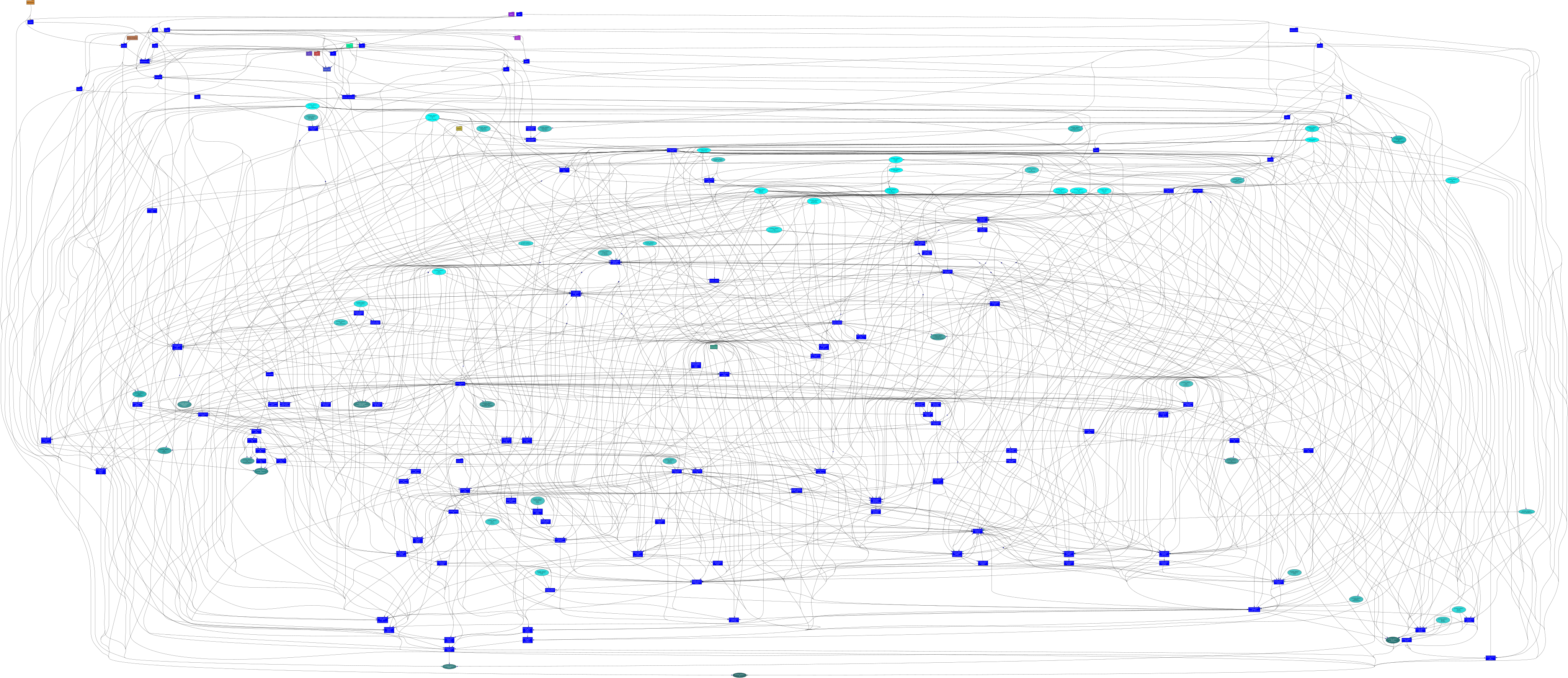
Generated by pydeps. Regenerate with make visualize (requires Graphviz).
Workflow call graph (function-level):
The following diagram shows which functions call which in the pipeline entry point (workflow/orchestration.py). Useful for understanding orchestration flow and hot paths.

Generated by pyan3.
Flowcharts: For control flow within key modules, see orchestration flowchart and service API flowchart (generated by code2flow).
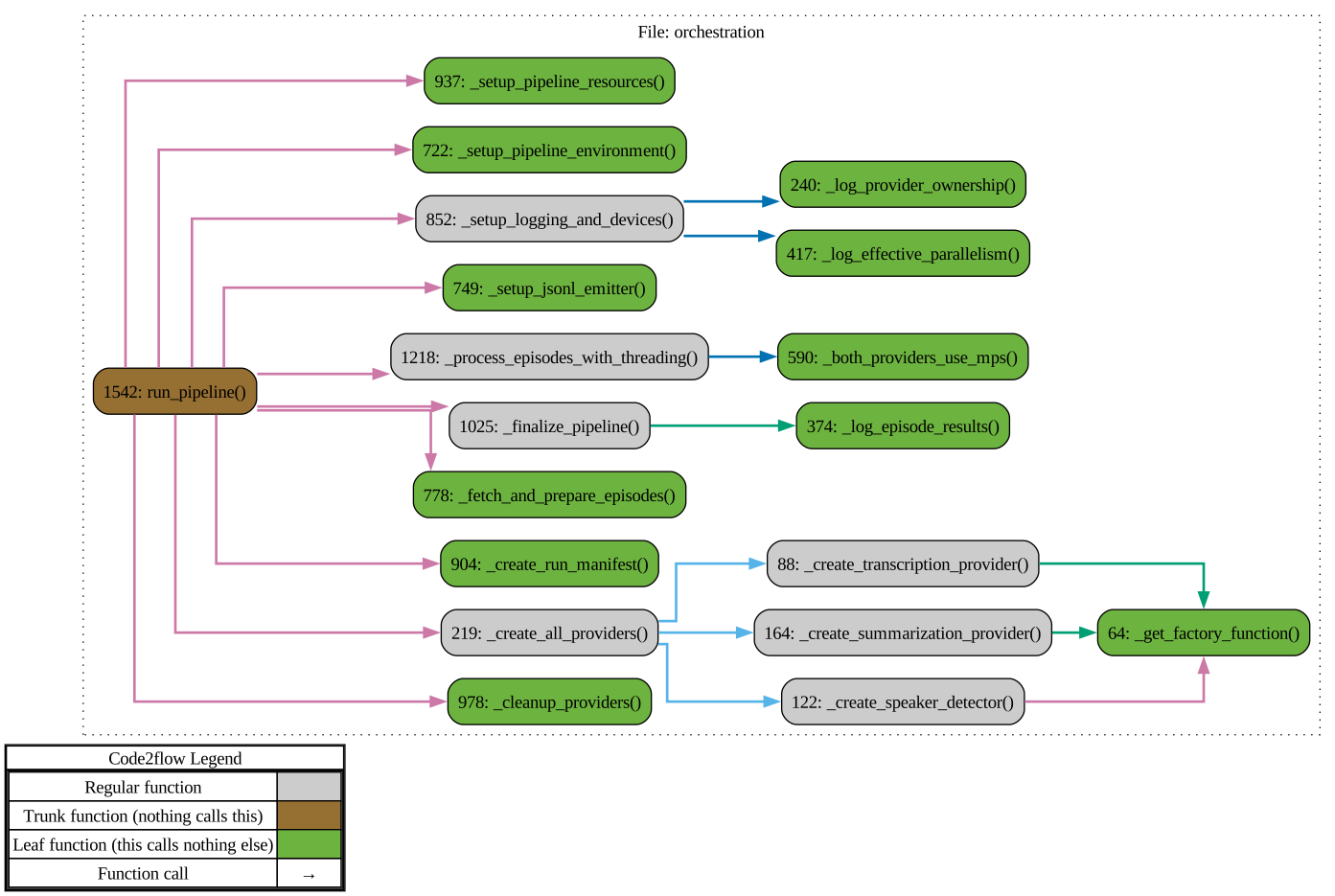
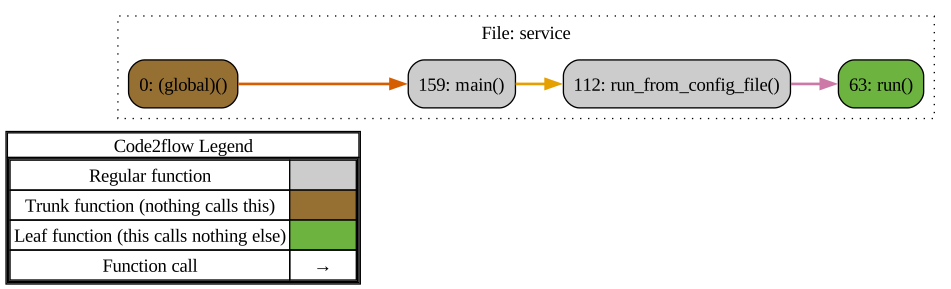
- Typed, immutable configuration:
Configis a frozen Pydantic model, ensuring every module receives canonicalized values (e.g., normalized URLs, integer coercions, validated Whisper models). This centralizes validation and guards downstream logic. - Resilient HTTP interactions: A per-thread
requests.Sessionwith exponential backoff retry (LoggingRetry) handles transient network issues while logging retries for observability. Retry counts and backoff factors are configurable viaConfigfields (http_retry_total,http_backoff_factor,rss_retry_total,rss_backoff_factor) with resilient defaults (8 retries / 1.0 s backoff for media; 10 retries / 2.0 s backoff for RSS). An additional application-level episode retry (episode_retry_max, default 1) re-runs the full episode download on transient network errors after urllib3 retries are exhausted. Model loading operations useretry_with_exponential_backofffor transient errors (network failures, timeouts). See CONFIGURATION.md -- Download Resilience. - Response-shape guardrails (ADR-099 / ADR-100): A second layer of defense above transport-level resilience.
providers/guardrails/runs content-aware sanity checks on every200 OKresponse from chat-completion providers (cloud + self-hosted) and from the self-hosted whisper / pyannote services. A response that fails the check (empty content, thinking-prose markers,finish_reason=length, mid-truncated JSON, single-speaker labels for multi-speaker audio) raisesGuardrailViolation, which theFallbackAwareSummarizationProviderwrapper routes the same way it routes connection-level failures. Per-stage policy: summary / GI / KG / speaker fail-up; cleaning degrades gracefully to the original transcript. Violations emit a Prometheus counter (inference_guardrail_violations_total{service, reason}) for alerting. See ADR-105 (self-hosted), ADR-100 (cloud). - Concurrent transcript pulls: Transcript downloads are parallelized via
ThreadPoolExecutor, guarded with locks when mutating shared counters/job queues. Whisper remains sequential to avoid GPU/CPU thrashing and to keep the UX predictable. - Deterministic filesystem layout: Output folders follow
output/rss_<host>_<hash>conventions. Optionalrun_idand Whisper suffixes create run-scoped subdirectories whilesanitize_filenameprotects against filesystem hazards. - Dry-run and resumability:
--dry-runwalks the entire plan without touching disk, while--skip-existingshort-circuits work per episode, making repeated runs idempotent. - Pluggable progress/UI: A narrow
ProgressFactoryabstraction lets embedding applications replace the defaulttqdmprogress without touching business logic. - Optional Whisper dependency: Whisper is imported lazily and guarded so environments without GPU support or
openai-whispercan still run transcript-only workloads. - Optional summarization dependency (PRD-005/RFC-012): Summarization requires
torchandtransformersdependencies and is imported lazily. When dependencies are unavailable, summarization is gracefully skipped. Models are automatically selected based on available hardware (MPS for Apple Silicon, CUDA for NVIDIA GPUs, CPU fallback). See ML Provider Reference for details. - Language-aware processing (RFC-010): A single
languageconfiguration drives both Whisper model selection (preferring English-only.envariants) and NER model selection. Production / cloud profiles default to the transformer-baseden_core_web_trffor higher entity-recall quality; dev / test paths use the smalleren_core_web_smfor speed. Both wheels are pip-installed viapyproject.toml. Profile YAMLs can pinner_model:explicitly to override the default. - Automatic speaker detection (RFC-010): Named Entity Recognition extracts speaker names from episode metadata transparently. Manual speaker names (
--speaker-names) are ONLY used as fallback when automatic detection fails, not as override. spaCy is a required dependency for speaker detection. - Host/guest distinction: Host detection prioritizes RSS author tags (channel-level only) as the most reliable source, falling back to NER extraction from feed metadata when author tags are unavailable. Guests are always detected from episode-specific metadata using NER, ensuring accurate speaker labeling in Whisper screenplay output. NER logic lives in
speaker_detectors/(modularized per RFC-059 / Wave 1). - Audio pipeline (Wave 1+2): Local Whisper and DGX tailnet Whisper support screenplay formatting with neural diarization (pyannote, default on) or gap-based fallback. Cloud providers use
AudioChunkerfor oversized uploads (#286). CommercialDetector removes sponsor blocks before summarization (#486 Phase 1; diarization-aware signals in Phase 2). Deepgram is a first-class transcription provider (#597). See Audio Pipeline Guide. - Provider-based architecture (RFC-013): All capabilities (transcription, speaker detection, summarization) use a protocol-based provider system. Providers are created via factory functions based on configuration, allowing pluggable implementations (e.g., Whisper vs OpenAI for transcription, NER vs OpenAI for speaker detection, local transformers vs OpenAI for summarization). Providers implement consistent interfaces (
initialize(), protocol methods,cleanup()) ensuring type safety and easy testing. See Provider Implementation Guide for complete implementation details. - Local-first summarization (PRD-005/RFC-012): Summarization defaults to local transformer models for privacy and cost-effectiveness. API-based providers (OpenAI) are supported via the provider system. Long transcripts are handled via chunking strategies, and memory optimization is applied for GPU backends (CUDA/MPS). Models are automatically cached and reused across runs, with cache management utilities available via CLI and programmatic APIs. Model loading prefers safetensors format for security and performance (Issue #379). Pinned model revisions ensure reproducibility (Issue #379).
- Reproducibility (Issue #379): Deterministic runs via seed control (
torch,numpy,transformers). Run manifests capture complete system state. Per-episode stage timings enable performance analysis. Run summaries combine manifest and metrics for complete run records. - Operational Hardening (Issue #379): Three-layer retry with configurable parameters and resilient defaults (see CONFIGURATION.md -- Download Resilience). Timeout enforcement for transcription and summarization. Failure handling flags (
--fail-fast,--max-failures) for pipeline control. Structured JSON logging for log aggregation. Path validation and model allowlist validation for security. End-of-runfailure_summaryinrun.jsonaggregates failed episodes by error type for triage.
Architecture Evolution¶
The system has evolved through four phases that expand ML capabilities and enable structured knowledge extraction. This section documents the architectural progression and how components integrate with the existing system.
Phase 1: Model Registry (RFC-044)¶
Status: Implemented
Centralizes all model metadata (architecture limits,
capabilities, memory footprint, device defaults) into
a ModelRegistry class in
providers/ml/model_registry.py. Eliminates hardcoded
model limits scattered across the codebase. Every model
(summarization, embedding, QA, NLI) is registered with
a ModelCapabilities dataclass.
Impact on existing architecture:
providers/ml/summarizer.py— uses registry for token limits instead of hardcoded valuesconfig.py— registry validates model selections- Module:
providers/ml/model_registry.py
Phase 2: Hybrid ML Platform (RFC-042)¶
Status: Implemented (Hybrid MAP-REDUCE summarization + embedding/QA/NLI extensions).
Implemented:
- Hybrid MAP-REDUCE summarization: Use
summary_provider: hybrid_mlwith MAP phase (LongT5-base or other transformers) and REDUCE phase via transformers (FLAN-T5), ollama (local LLMs, e.g. llama3.1:8b, mistral:7b), or llama_cpp (GGUF). See ML Provider Reference and Ollama Provider Guide (Ollama as REDUCE backend). - Layered transcript cleaning (Issue #419): Workflow
transcript_cleaning_strategy/cleaning_processorruns beforeHybridMLProvider.summarize; internal preprocessing defaults tocleaning_v4, withcleaning_hybrid_after_patternwhen strategy ispattern(fieldhybrid_internal_preprocessing_after_pattern). See RFC-042 § Layered transcript cleaning.
New modules (present):
providers/ml/hybrid_ml_provider.py— Hybrid MAP-REDUCE provider; REDUCE backends: transformers, Ollama, llama.cpp
Implemented (Phase 2 extensions):
providers/ml/embedding_loader.py— Sentence-transformers for topic deduplicationproviders/ml/extractive_qa.py— Extractive QA for grounding validationproviders/ml/nli_loader.py— NLI cross-encoders for entailment checkingMLProviderextensions with embedding, QA, NLI models (lazy-loaded)
Phase 2b: Local LLM Prompt Optimization (RFC-052)¶
Status: Implemented (parallel with Phase 2)
Creates model-specific prompt templates for Ollama
models (Qwen2.5, Llama 3.1, Mistral 7B, Gemma 2,
Phi-3). Adds GIL extraction prompts
(extraction/insight_v1.j2, topic_v1.j2,
quote_v1.j2) to the existing prompts/ structure.
Impact on existing architecture:
- New prompt directories under
prompts/ollama/ - No structural changes; extends existing
PromptStore
Phase 2c: Audio pipeline (Wave 1 + Wave 2)¶
Status: Partial (Wave 1 merged; Wave 2 diarization + commercial Phase 2 in flight)
Wave 1 (PR #850):
speaker_detectors/— modular NER/heuristic speaker detection (#269)preprocessing/audio/chunker.py— API upload chunking (#286)cleaning/commercial/—CommercialDetectorPhase 1 (#486)providers/deepgram/— Nova-3 transcription provider (#597)- Whisper progress UX — single batch bar (#19)
Wave 2:
providers/ml/diarization/— pyannote additive pass;diarize=truedefault for local Whisper (#482)cleaning/commercial/diarization_signals.py— Phase 2 commercial signals (#488)- DGX
tailnet_dgx_whisperincluded in diarize/screenplay coercion
Impact on existing architecture:
workflow/episode_processor.py— diarization hook after transcription; chunking for API providerspreprocessing/core.py— delegates sponsor removal toCommercialDetector- Config —
diarize,hf_token,deepgram_*fields; profiles updated
See Audio Pipeline Guide, RFC-058, RFC-060.
Phase 3: Grounded Insight Layer (RFC-049)¶
Status: Implemented
Structured knowledge extraction in the pipeline:
Transcript → Insight Extraction → Quote Extraction
    → Grounding (Insight↔Quote linking)
    → Topic Assignment → gi.json
Modules (implemented):
gi/pipeline.py— GIL orchestration (called after summarization in pipeline)gi/schema.py—gi.jsonvalidation againstdocs/architecture/gi/gi.schema.jsongi/io.py— Serializes GIL output togi.jsonper episodegi/grounding.py— Insight↔Quote grounding logicgi/contracts.py— Grounding contract enforcementgi/explore.py— GIL data exploration utilitiesgi/corpus.py— Cross-episode corpus operationsgi/quality_metrics.py— GIL quality scoringgi/provenance.py— Provenance trackinggi/compare_runs.py— Cross-run comparison
Three extraction tiers:
| Tier | Models | Quality | Cost |
|---|---|---|---|
| ML-only | FLAN-T5 + RoBERTa QA + NLI | Good | Free |
| Hybrid | Ollama (Qwen/Llama) + QA | Better | Free |
| Cloud LLM | OpenAI/Gemini + QA | Best | API cost |
All tiers use extractive QA for grounding contract compliance (every quote must be verbatim).
Phase 3a: KG Extraction (RFC-055)¶
Status: Implemented
Knowledge Graph extraction produces structured topic graphs from transcripts and summaries.
Modules (implemented):
kg/pipeline.py— KG extraction orchestrationkg/schema.py— KG schema validationkg/io.py— Serializes KG output tokg.jsonkg/llm_extract.py— LLM-based KG extractionkg/contracts.py— KG contract enforcementkg/corpus.py— Cross-episode KG operationskg/quality_metrics.py— KG quality scoringkg/cli_handlers.py— KG CLI subcommands
Phase 3b: Use Cases & DB Projection¶
RFC-050 (Use Cases): Implemented. CLI commands
(gi inspect, gi show-insight, gi explore) for
consuming GIL data. See gi/explore.py.
RFC-051 (Database Projection): Projects gi.json
(GIL) and KG artifacts (RFC-055) into separate
Postgres tables for fast SQL queries (e.g. GIL:
insights, quotes, insight_support; KG: kg_nodes,
kg_edges per RFC-051). Enables Insight Explorer,
notebook workflows, and KG discovery queries.
Phase 4: Adaptive Routing (RFC-053)¶
Status: Planned
Selects optimal summarization and extraction strategies based on episode characteristics (duration, structure, content type). Uses episode profiling and deterministic routing rules. Enables expansion beyond podcasts to interviews, lectures, panels, etc.
Phase 5: Server & Viewer (RFC-062)¶
Status: Implemented (M1–M7)
FastAPI server in src/podcast_scraper/server/ with
Vue 3 SPA in web/gi-kg-viewer/. CLI: podcast serve.
See Server Guide for the
API route table and
Viewer Frontend Architecture
for the SPA internals (component tree, Pinia stores,
API client layer, async correctness).
Phase 5a: Corpus Search — Hybrid over LanceDB (RFC-061 → RFC-090 → ADR-099)¶
Status: Implemented. FAISS semantic search (RFC-061) shipped historically; hybrid retrieval (RFC-090) is the default (v2.7+), and FAISS was fully retired (ADR-099, #995) — LanceDB is now the only search backend.
Hybrid retrieval (RFC-090, always-on). A two-tier index — transcript segments (Tier 1)
and GIL insights (Tier 2) — with BM25 + dense vector fused via RRF over an embedded LanceDB
backend, compound results (a segment and its linked insight merged), and rules-based intent
routing. The live /api/search path routes through the two-tier hybrid RetrievalLayer; when no
usable index exists the response is no_index — there is no FAISS fallback (FAISS retired #995).
KG-proximity was evaluated as a third signal and rejected (RFC-091); relational structure comes
from typed edges in the cross-layer graph (Person→Insight, Insight→Entity,
Podcast→Episode, #874) consumed by surfaces — not by ranking.
Semantic search (sentence-transformers embeddings). Corpus-wide LanceDB indexing, CLI
(podcast search) and HTTP (/api/search). Multi-feed corpora use a single unified index under
<corpus>/search/lance_index/.
Index lifecycle (bounded growth). LanceDB is MVCC and the indexer upserts per document, so
each build appends data fragments + superseded versions. To keep the index bounded across the
incremental reindex the pipeline runs after every batch, build_two_tier_index compacts
each table at the end (Table.optimize(cleanup_older_than=_COMPACT_RETENTION) — merges fragments
and prunes versions older than a ~10-minute grace window that keeps superseded fragments readable
for any in-flight api read). Without this the index grew unbounded (a real reprocessed corpus
reached ~3.8G of stale fragments before the fix). A full reindex (index-two-tier,
index --rebuild, drop_existing) does not delete the index directory — the old rmtree
yanked fragment files out from under concurrent readers, stranding them with a Not found (#1206).
Instead it clears via MVCC in place: the first flush of each tier overwrite-replaces its table
(a new version in the same dir), and any tier that receives no rows is MVCC-emptied at the end, so
readers pinned to the prior version keep resolving their fragments through the retention window.
Modules (implemented):
search/two_tier_indexer.py— native two-tier (segment + insight + aux) LanceDB index buildsearch/backends/lancedb_backend.py— LanceDB BM25 + vector backendsearch/retrieval.py—RetrievalLayer(signals → RRF → compound dedup)search/hybrid_search.py— live hybrid bridge (no FAISS fallback; missing index →no_index)search/relational_edges.py,gi/speakers.py— derived relational edges (#874)search/indexer.py— corpus index buildsearch/chunker.py— Transcript chunkingsearch/protocol.py—VectorStore/SearchResultprotocolssearch/corpus_search.py— Shared search logicsearch/corpus_similar.py— Episode similaritysearch/corpus_scope.py— Multi-feed identitysearch/cli_handlers.py— CLI subcommands
Phase 5b: Corpus Library (RFC-067)¶
Status: Implemented (Phases 1–3)
Filesystem-backed corpus catalog exposed via
/api/corpus/* endpoints. Episode similarity via
search handoff (Phase 3). Viewer Library tab
documented in
Viewer Frontend Architecture.
Phase 5c: Corpus Digest (RFC-068)¶
Status: Implemented
Time-windowed episode digest with topic-band
classification. /api/corpus/digest endpoint.
Configurable via config/digest_topics.yaml. Viewer
Digest tab documented in
Viewer Frontend Architecture.
Phase 5d: Graph Exploration Toolkit (RFC-069)¶
Status: In progress
Extends the viewer graph canvas with zoom controls, minimap, degree filter, and alternative layouts. Viewer graph internals documented in Viewer Frontend Architecture.
Execution Order Summary¶
Phase 1: RFC-044 (Model Registry)       Implemented
Phase 2: RFC-042 (Hybrid ML Platform)   Implemented (core + extensions)
    2b:  RFC-052 (LLM Prompts)          Implemented
Phase 3: RFC-049 (GIL Core)             Implemented
    3a:  RFC-050 (Use Cases)            Implemented
    3b:  RFC-051 (DB Projection)        planned
    3c:  KG Extraction (RFC-055)        Implemented
Phase 4: RFC-053 (Adaptive Routing)     planned
Phase 5: RFC-062 (Server & Viewer)      Implemented
    5a:  Corpus Search (RFC-061→090)    Implemented (Hybrid over LanceDB; FAISS retired #995)
    5b:  RFC-067 (Corpus Library)       Implemented (Phases 1–3)
    5c:  RFC-068 (Corpus Digest)        Implemented
    5d:  RFC-069 (Graph Exploration)    in progress
Third-Party Dependencies¶
The project uses a layered dependency approach: core dependencies (always required) provide essential functionality, while ML dependencies (optional) enable advanced features like transcription and summarization.
Core Dependencies: requests, pydantic,
defusedxml, tqdm, platformdirs, PyYAML,
Jinja2
ML Dependencies (optional, install via
pip install -e .[ml]): openai-whisper, spacy,
torch, transformers, sentencepiece,
sentence-transformers, lancedb, accelerate, protobuf,
llama-cpp-python (GGUF / hybrid REDUCE, RFC-042)
API Provider Dependencies:
- Core:
openai(OpenAI, DeepSeek, Grok OpenAI-compat) - Optional
[llm]extra:google-genai,google-api-core,anthropic,mistralai,httpx(Ollama health checks; Ollama itself is a separate local server)
Other optional extras: [compare] (Streamlit run comparison, RFC-047), [dev] (tooling, typecheck, security, and FastAPI / uvicorn for the RFC-062 viewer API), [monitor] (optional profiling, RFC-065)
Search dependencies (included in [ml]):
sentence-transformers (embeddings), lancedb
(vector storage and retrieval)
For detailed dependency information including rationale, alternatives considered, version requirements, and dependency management philosophy, see Dependencies Guide.
Module Dependency Analysis¶
The project uses pydeps for visualizing module dependencies, detecting circular imports, and tracking architectural health over time. This tooling helps maintain clean module boundaries and identify coupling issues early. The dependency graph is integrated into this document above (see Module Dependencies Diagram).
Tools and Commands¶
Makefile Targets:
make deps-graph- Generate module dependency graphs (SVG) indocs/architecture/make deps-graph-full- Generate full module dependency graph with all dependenciesmake call-graph- Generate workflow call graph (pyan3, orchestration entry point)make flowcharts- Generate flowcharts for orchestration and service (code2flow)make visualize- Generate all architecture visualizations (deps + call graph + flowcharts) intodocs/architecture/make release-docs-prep- Regenerate diagrams and create release notes draft before release, then commitmake deps-check- Check dependencies and exit with error if issues foundmake deps-analyze- Run full dependency analysis with JSON report
Analysis Script:
python scripts/tools/analyze_dependencies.py- Analyze dependencies and detect issues--check- Exit with error if issues found--report- Generate detailed JSON report
Note: Generating SVG graphs requires Graphviz (dot on PATH). Install with brew install graphviz (macOS) or your system package manager.
Key Metrics¶
| Metric | Description | Threshold |
|---|---|---|
| Max depth | Longest dependency chain | <5 levels |
| Circular imports | Cycles in import graph | 0 |
| Fan-out | Modules a file imports | <15 |
| Fan-in | Modules importing a file | Monitor only |
CI Integration¶
Dependency analysis runs automatically in the nightly workflow:
- Generates dependency graphs (SVG) for visualization
- Checks for circular imports
- Runs full dependency analysis with JSON report
- Artifacts are uploaded for download (90-day retention)
Output Files¶
docs/architecture/diagrams/dependency-graph.svg- Module dependency graph (clustered, for documentation)docs/architecture/diagrams/dependency-graph-simple.svg- Simplified dependency graph (clustered, max-bacon=2)docs/architecture/diagrams/dependency-graph-full.svg- Full dependency graph with all dependencies (frommake deps-graph-full)docs/architecture/diagrams/workflow-call-graph.svg- Function call graph for orchestration (frommake call-graph, pyan3)docs/architecture/diagrams/orchestration-flow.svg,service-flow.svg- Flowcharts for orchestration and service (frommake flowcharts, code2flow)reports/deps-analysis.json- Detailed analysis report (when usingmake deps-analyzeor script--report)
Related Documentation¶
- Architecture visualizations - Generated diagrams in
docs/architecture/diagrams/ - RFC-038: Continuous Review Tooling - Module coupling analysis implementation
- Issue #170 - Module coupling analysis tooling
- Issue #425 - Codebase visualization tools for documentation
- CI/CD Documentation - Nightly workflow details
Constraints and Assumptions¶
- Python 3.10+ with third-party packages:
requests,tqdm,defusedxml,platformdirs,pydantic,PyYAML,Jinja2,spacy(required for speaker detection), and optionallyopenai-whisper+ffmpegwhen ML transcription is required, and optionallytorch+transformerswhen ML summarization is required. - Network-facing operations assume well-formed HTTPS endpoints; malformed feeds raise early during parsing to avoid partial state.
- The system supports 9 providers with different
capability profiles (see provider table above).
Provider selection is driven by
Configfields (transcription_provider,speaker_detector_provider,summary_provider). - Whisper transcription supports multiple languages
via
languageconfiguration, with English ("en") as the default. Transcription remains sequential by design; concurrent transcription is intentionally out of scope due to typical hardware limits. - Speaker name detection via NER (RFC-010) requires
spaCy. When automatic detection fails, the system
falls back to manual speaker names (if provided) or
default
["Host", "Guest"]labels. - Output directories must live in safe roots (cwd, user home, or platform data/cache dirs); other locations trigger warnings for operator review.
- GIL extraction produces
gi.jsonper episode conforming to a versioned schema. The grounding contract requires every quote to be verbatim and every insight to declare grounding status. - KG extraction produces
kg.jsonper episode with structured topic graphs derived from transcripts and summaries.
Configuration Flow¶
flowchart TD
    Input[CLI Args + Config Files] --> Merge[Merge Sources]
    Merge --> Validate[Pydantic Validation]
    Validate --> Normalize[Normalize Values]
    Normalize --> Config[Immutable Config Object]
    Config --> Workflow[workflow.orchestration.run_pipeline]
    Config --> EpisodeProc[workflow.episode_processor]
    Config --> RSSParser[rss.parser]
    Config --> Downloader[rss.downloader]
    Config --> Whisper[providers.ml.whisper_utils]
    Config --> SpeakerDetect[providers.ml.speaker_detection]
    Config --> Metadata[workflow.metadata_generation]
    Config --> Summarizer[providers.ml.summarizer]

    style Input fill:#e1f5ff
    style Config fill:#fff3cd
style Validate fill:#f8d7damodels.Episodeencapsulates the RSS item, chosen transcript URLs, and media enclosure metadata, keeping parsing concerns separate from processing.- Transcript filenames follow
<####> - <episode_title>[ _<run_suffix>].<ext>with extensions inferred from declared types, HTTP headers, or URL heuristics. - Whisper output names append the Whisper model/run identifier to differentiate multiple experimental runs inside the same base directory. Screenplay formatting uses detected speaker names when available.
- Temporary media downloads land in
<output>/ .tmp_media/and always get cleaned up (best effort) after transcription completes. - Episode metadata documents (per PRD-004/RFC-011)
are generated when
generate_metadatais enabled, storing detected speaker names, feed information, transcript sources, and other episode details alongside transcripts in JSON/YAML format for downstream use cases. When summarization is enabled, metadata documents include summary and key takeaways fields with model information and generation timestamps. - GIL artifacts (PRD-017): When GIL extraction is
enabled, a
gi.jsonfile is generated per episode containing structured insights, verbatim quotes, topics, and their grounding relationships. The file conforms todocs/architecture/gi/gi.schema.jsonand is co-located with other episode artifacts. - KG artifacts (RFC-055): When KG extraction is
enabled, a
kg.jsonfile is generated per episode containing structured topic graphs. - Run tracking files (Issue #379, #429): The pipeline writes
run.json,index.json,run_manifest.json, andmetrics.jsonin each run directory. See Pipeline and Workflow Guide - Run tracking files for details.
Filesystem Layout¶
graph TD
    Root[output/rss_hostname_hash/] --> RunDir{Run ID<br/>Specified?}
    RunDir -->|Yes| RunSubdir[run_id/]
    RunDir -->|No| BaseDir[Base Directory]
    RunSubdir --> Episodes[Episode Files]
    BaseDir --> Episodes
    Episodes --> Transcript1["0001 - Episode Title.txt"]
    Episodes --> Transcript2["0002 - Episode Title.txt"]
    Episodes --> WhisperDir{Whisper<br/>Used?}
    WhisperDir -->|Yes| WhisperSubdir[whisper_model_run/]
    WhisperSubdir --> WhisperFiles["0001 - Episode Title_whisper_base.txt"]
    Episodes --> Metadata{Metadata<br/>Enabled?}
    Metadata -->|Yes| MetaFiles["0001 - Episode Title.json<br/>0001 - Episode Title.yaml"]
    Episodes --> GIL{GIL<br/>Enabled?}
    GIL -->|Yes| GIFile["gi.json<br/>Insights + Quotes + Edges"]
    Episodes --> KGCheck{KG<br/>Enabled?}
    KGCheck -->|Yes| KGFile["kg.json<br/>Topic Graph"]
    Root --> TempDir[.tmp_media/]
    TempDir --> TempFiles[Temporary Media Files<br/>Cleaned Up After Use]

    style Root fill:#e1f5ff
    style Episodes fill:#fff3cd
    style TempDir fill:#f8d7da
style Metadata fill:#d1ecf1- RSS and HTTP failures raise
ValueErrorearly with descriptive messages; CLI wraps these in exit codes for scripting. - Transcript/Media downloads log warnings rather than hard-fail the pipeline, allowing other episodes to proceed.
- Filesystem operations sanitize user-provided paths, emit warnings when outside trusted roots, and handle I/O errors gracefully.
- Unexpected exceptions inside worker futures are caught and logged without terminating the executor loop.
For detailed error handling patterns and implementation guidelines, see Development Guide - Error Handling.
Extensibility Points¶
- Configuration: Extend
Config(and CLI) when introducing new features; validation rules keep downstream logic defensive. Language and NER configuration (RFC-010) demonstrate this pattern. - Progress: Replace
progress.set_progress_factoryto integrate with custom UIs or disable progress output entirely. - Download strategy:
downloadercentralizes HTTP behavior—alternate adapters or auth strategies can be injected by decoratingfetch_url/http_get. - Episode transforms: New transcript processors can reuse
models.Episodeandfilesystemhelpers without modifying the main pipeline. - CLI embedding:
cli.mainaccepts override callables (apply_log_level_fn,run_pipeline_fn,logger) to facilitate testing and reuse from other entry points. - Speaker detection (RFC-010): NER implementation is modular and can be extended with custom heuristics, additional entity types, or alternative NLP libraries. Configuration allows disabling detection behavior or providing manual fallback names.
- Language support: Language configuration drives both Whisper and NER model selection, enabling multi-language support through consistent configuration. New languages can be added by extending model selection logic and spaCy model support.
- Metadata generation (PRD-004/RFC-011): Metadata document generation is opt-in and can be extended with additional fields or alternative output formats. The schema is versioned to support future evolution.
- Provider system (RFC-013): The provider architecture enables extensibility for all capabilities. New providers can be added by implementing protocol interfaces and registering in factory functions. The system supports 9 providers: 1 local ML + 1 hybrid ML + 7 LLM (OpenAI, Gemini, Anthropic, Mistral, DeepSeek, Grok, Ollama). E2E testing infrastructure includes mock endpoints for API providers. See Provider Implementation Guide for complete implementation patterns.
- Prompt templates (RFC-017): LLM providers use
versioned Jinja2 prompt templates managed by
PromptStore. New tasks can be added by creating<provider>/<task>/<version>.j2files. GIL extraction prompts will follow this pattern. - Summarization (PRD-005/RFC-012): Summarization is opt-in and integrated with metadata generation. Local transformer models are preferred for privacy and cost-effectiveness, with automatic hardware-aware model selection. The implementation supports multiple model architectures (BART, PEGASUS, LED, DistilBART) and all 7 LLM providers via prompt templates. Long transcript handling via chunking strategies ensures scalability.
- GIL Extraction (PRD-017): The Grounded Insight
Layer is an opt-in pipeline stage that produces
gi.jsonfiles per episode. The three-tier extraction model (ML-only, Hybrid, Cloud LLM) reuses the existing provider architecture. New extraction capabilities can be added by implementing theStructuredExtractorprotocol (RFC-042). Thegi.jsonschema is versioned and validated againstdocs/architecture/gi/gi.schema.json. - KG Extraction (RFC-055): Knowledge Graph
extraction is an opt-in pipeline stage that produces
kg.jsonfiles per episode. Supports stub, summary-bullet-derived, and LLM-based extraction modes viakg_extraction_sourceconfig. - Server / viewer (RFC-062): The FastAPI server in
server/exposes REST endpoints wrapping existing Python APIs. New route groups can be added by creating a router inroutes/and including it inapp.py. See Server Guide and Viewer Frontend Architecture.
Operational Tooling¶
Beyond the core src/ package, the repository includes
standalone tools and scripts that support development,
evaluation, and operations.
tools/run_compare/ (RFC-047, RFC-066)¶
Streamlit UI for comparing ML evaluation runs from
data/eval/ artifacts (metrics.json,
predictions.jsonl, optional diagnostics.jsonl).
Install via pip install -e '.[compare]'; run with
make run-compare.
Pages: Home (token/latency charts, ROUGE
aggregates), KPIs (wide table with ROUGE-L F1),
Delta (baseline vs candidates), Episodes
(intersection comparison, diffs), Performance
(RFC-066 — frozen profiles from
data/profiles/*.yaml joined by release key;
resource deltas, per-stage trends, quality-vs-cost
scatter). See
RFC-047 (moved to the private eval repo as RFC-007)
and
RFC-066 (moved to the private eval repo as RFC-009).
scripts/ Directory¶
Utility scripts organized by purpose. All have
corresponding make targets — never invoke scripts
directly.
| Folder | Purpose | Key scripts |
|---|---|---|
acceptance/ |
E2E acceptance test runners and analysis | run_acceptance_tests.py, analyze_bulk_runs.py |
cache/ |
ML model cache management | preload_ml_models.py, backup_cache.py, restore_cache.py |
dashboard/ |
CI/nightly metrics collection, dashboard generation, JSONL history | generate_metrics.py, generate_dashboard.py, consolidate_dashboard_data.py, collect_pipeline_metrics.py |
eval/ |
The two ranking scorers the viewer's Discover surface is graded by | rank_discover_v1.py, rank_scenarios_v1.py |
tools/ |
Dev tooling: dependency analysis, markdown fix, schema validation, testing policy enforcement | analyze_dependencies.py, fix_markdown.py, check_unit_test_imports.py, check_test_policy.py |
See scripts/README.md for detailed usage and
make target mappings.
config/ Directory¶
Runtime configuration organized by use case.
| Folder | Purpose |
|---|---|
acceptance/ |
Acceptance fast matrix (MAIN_ACCEPTANCE_CONFIG.yaml) + fragments; optional local YAML presets |
ci/ |
CI-oriented local-only files (gitignored except README.md; not used for acceptance fast list) |
examples/ |
Example YAML/JSON configs and .env.example for onboarding |
manual/ |
Manual/benchmark-oriented configs (GI/KG, multi-feed variants) |
playground/ |
Experimental user-specific configs |
profiles/ |
Deployment YAML; profiles/freeze/ for RFC-064 capture presets; frozen snapshots in data/profiles/ |
Root files: digest_topics.yaml (Corpus Digest
topic-band config, RFC-068),
pricing_assumptions.yaml (cost estimation).
Process Safety for ML Workloads (RFC-074)¶
ML model loading (spaCy, Transformers, Whisper) involves heavy filesystem
I/O -- readdir(), lstat(), mmap() on multi-GB files. On macOS (APFS),
this contends for a global kernel lock, and processes can enter
uninterruptible wait (UE state) where even kill -9 has no effect.
Repeated make invocations (especially from agentic tooling) amplify the
problem into a pileup that can corrupt APFS metadata and prevent login
after reboot.
Mitigations in the build system¶
| Layer | Mitigation | Location |
|---|---|---|
| Makefile parse time | No $(shell ...) calls that import ML libraries; PYTEST_WORKERS is a static default |
Makefile |
| ML cache checks | Filesystem-only probes (config.json + weight file existence) instead of AutoTokenizer.from_pretrained() |
tests/integration/ml_model_cache_helpers.py |
| CI targets | cleanup-processes runs as a prerequisite to ci and ci-fast |
Makefile |
| Offline mode | Pytest: tests/conftest.py; make ci probe: inline env; preload/smoke: env -u so Hub works |
Makefile, tests/conftest.py |
| Pre-commit hook | 120-second watchdog timeout; process group cleanup on exit (kill -- -$$) |
.github/hooks/pre-commit |
| Preload script | 1200-second signal.alarm hard timeout |
scripts/cache/preload_ml_models.py |
| Agent rules | Process safety — ML workloads in AGENTS.md: no retrying stuck commands, no overlapping make ci, mandatory cleanup-processes after hung runs |
AGENTS.md |
| Session hook | Cursor sessionStart hook runs check-zombie.sh to detect UE processes before any work begins |
.cursor/hooks/ |
Diagnostic targets¶
make check-zombie      # Detect unkillable (UE state) Python processes
make check-spotlight   # Verify Spotlight indexing status (macOS)
make cleanup-processes # Kill leftover Python/test processes
check-zombie and check-spotlight are advisory -- they are not wired
into ci-fast or ci and never block builds. cleanup-processes runs
automatically before every ci and ci-fast invocation.
Recovery¶
If check-zombie reports UE processes, reboot is the only option. After
reboot, run Disk Utility First Aid on the boot volume. Full recovery
runbook: RFC-074.
Testing¶
The project follows a three-tier testing strategy (Unit, Integration, E2E). For comprehensive testing information:
| Document | Purpose |
|---|---|
| Testing Strategy | Testing philosophy, test pyramid, decision criteria |
| Testing Guide | Quick reference, test execution commands |
| Unit Testing Guide | Unit test mocking patterns and isolation |
| Integration Testing Guide | Integration test guidelines |
| E2E Testing Guide | E2E server, real ML models |
| Critical Path Testing Guide | What to test, prioritization |
| Provider Implementation Guide | Provider-specific testing |
| Server Guide | Server API testing, Playwright E2E |